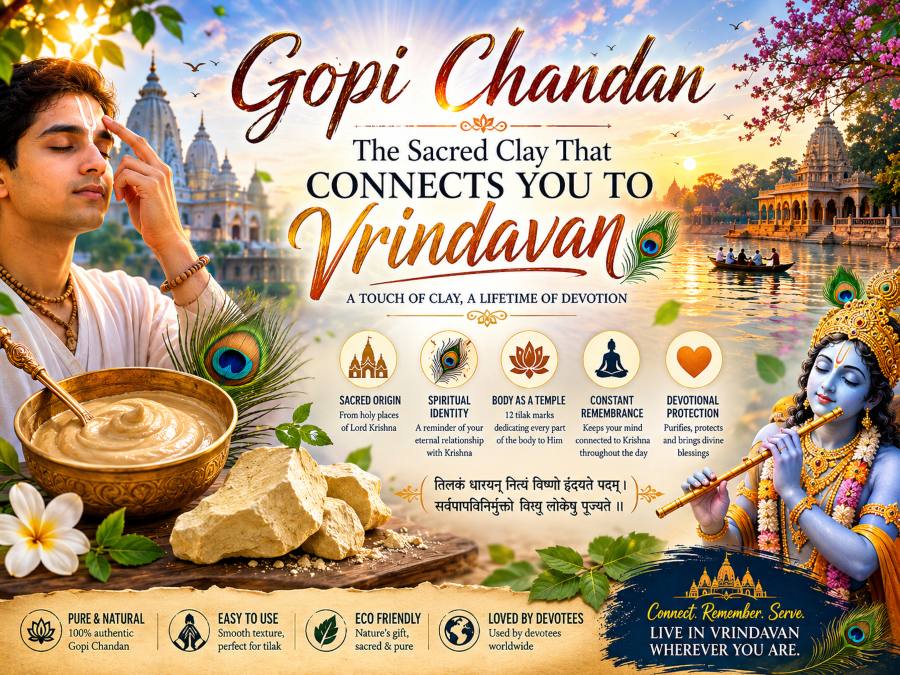
Gopi Chandan — The Sacred Clay That Connects You to Vrindavan
What if a small piece of sacred clay could transform an ordinary morning into a spiritual experience?
Every day, thousands of Vaishnava devotees carefully apply tilak using ISKCON Mayapur Store Gopi Chandan before chanting, worshipping, studying scripture, or beginning their daily activities. To an outsider, it may seem like a simple religious tradition. Yet for those who understand its deeper meaning, Gopi Chandan is far more than clay.
It is a symbol of surrender.
A reminder of Krishna.
A connection to sacred places.
And for many devotees, it serves as a bridge between their daily life and the eternal spiritual atmosphere of Vrindavan.
The story of Gopi Chandan stretches across centuries of devotion, sacred geography, scriptural tradition, and personal spiritual practice. Its significance cannot be measured by appearance alone. The true value of Gopi Chandan lies in what it helps devotees remember.
When applied with devotion, it becomes a daily invitation to reconnect with Krishna.
Why Sacred Clay Holds Such a Special Place in Bhakti
At first glance, clay seems ordinary.
People walk on it.
Build with it.
Dig through it.
Yet throughout spiritual history, certain forms of earth have been regarded as sacred because of their connection with divine activities.
In Vaishnava tradition, holy places are not viewed as ordinary locations. They are understood to be spiritually charged because they are associated with the pastimes of the Supreme Lord and His devotees.
Just as pilgrims treasure water from sacred rivers, devotees cherish sacred clay connected to Krishna’s eternal pastimes.
Gopi Chandan belongs to this category.
Its importance comes not from its physical composition but from its spiritual association.
This distinction is important.
A scientist may analyze the clay and identify minerals.
A devotee sees something deeper.
They see a sacred reminder of Krishna and His eternal abode.
Both perspectives describe the same object, yet they focus on entirely different dimensions of reality.
What Exactly Is Gopi Chandan?
Gopi Chandan is a sacred yellowish clay traditionally collected from the holy region associated with Lord Krishna’s pastimes in Dwaraka.
For centuries, Vaishnava saints, teachers, and devotees have used this clay to prepare tilak markings on the body.
The word itself carries devotional significance.
Within Vaishnava culture, Gopi Chandan is regarded as spiritually purifying and suitable for worship because of its sacred origin and scriptural acceptance.
It is most commonly used to create the distinctive U-shaped Vaishnava tilak seen on devotees around the world.
Today, whether one visits temples in India, Europe, America, Africa, or Australia, the same tradition continues.
The clay may travel thousands of miles.
Its spiritual meaning remains unchanged.
More Than a Mark on the Forehead
One of the biggest misunderstandings about Gopi Chandan is the belief that it functions merely as a religious symbol.
In reality, the purpose goes much deeper.
Tilak serves as a reminder.
Every time devotees apply Gopi Chandan, they consciously remember:
- Krishna
- Their spiritual identity
- Their relationship with God
- Their commitment to devotional service
This simple daily practice creates a powerful psychological and spiritual effect.
Most people begin their mornings thinking about responsibilities, deadlines, finances, or personal concerns.
A devotee begins differently.
Before entering the demands of the world, they pause.
They remember Krishna.
That pause changes the direction of the day.
Over months and years, those moments accumulate into a powerful habit of spiritual remembrance.
The Hidden Connection Between Gopi Chandan and Vrindavan
A thoughtful question often arises.
If Gopi Chandan is traditionally associated with Dwaraka, why do devotees describe it as connecting them to Vrindavan?
The answer reveals something beautiful about Krishna consciousness.
Vrindavan is not merely a geographical location.
It is a state of consciousness centered entirely on loving devotion to Krishna.
In the deepest sense, Vrindavan represents pure remembrance of the Lord.
When devotees apply Gopi Chandan and remember Krishna, they cultivate that same devotional consciousness.
The clay itself becomes a spiritual reminder.
Through remembrance, prayer, chanting, and service, the heart gradually moves closer to the mood of Vrindavan.
This connection is internal rather than geographical.
A devotee may live thousands of miles away from India and still feel spiritually connected to Vrindavan through sincere devotional practice.
Gopi Chandan helps nurture that connection.
Why Devotees Call the Body a Temple
Modern culture often teaches people to identify completely with the body.
Spiritual traditions offer a different perspective.
According to Vaishnava philosophy, the body is not the self.
The body is a temporary vehicle.
The true self is the eternal soul residing within.
This understanding changes everything.
When devotees apply Gopi Chandan, they are acknowledging that the body belongs to Krishna and should be used in His service.
The body becomes a temple.
The tilak becomes a sacred marking that designates the body as a place dedicated to divine remembrance.
This perspective elevates daily life.
Ordinary activities gain spiritual purpose when connected to devotion.
Eating becomes an opportunity to honor prasadam.
Speaking becomes an opportunity to glorify Krishna.
Working becomes an opportunity to serve.
The tilak serves as a daily reminder of this sacred responsibility.
The Spiritual Psychology Behind Tilak
Human beings naturally respond to symbols.
Consider how uniforms influence behavior.
A police officer, doctor, monk, or soldier often feels a heightened sense of responsibility while wearing clothing associated with their role.
Tilak functions similarly.
When devotees see Gopi Chandan on their forehead, they remember who they aspire to be.
The symbol reinforces values such as:
- Humility
- Compassion
- Self-control
- Service
- Gratitude
- Devotion
This is not superstition.
It is a practical application of spiritual psychology.
External reminders support internal transformation.
The mark on the forehead influences the thoughts within the mind.
Over time, this relationship becomes increasingly powerful.
The Ancient Tradition Preserved Through Generations
Many spiritual practices disappear with time.
Others survive because they continue offering meaningful benefits.
Gopi Chandan belongs to the second category.
Generation after generation, devotees have preserved this practice because it continues helping people remember Krishna.
Saints applied it.
Teachers applied it.
Temple priests applied it.
Householders applied it.
Students applied it.
The continuity itself tells an important story.
Practices that lack value eventually fade away.
Practices that nourish spiritual life endure.
The continued use of Gopi Chandan across centuries speaks to its enduring significance within Vaishnava culture.
Why Simplicity Often Carries the Deepest Wisdom
One fascinating aspect of bhakti is its simplicity.
Modern life often associates value with complexity.
People assume profound results require complicated systems.
Bhakti frequently works differently.
A simple prayer can transform the heart.
A simple mantra can change consciousness.
A simple offering can express profound devotion.
Gopi Chandan reflects this principle beautifully.
It is not expensive.
It is not technologically advanced.
It is not complicated.
Yet it carries immense spiritual meaning.
This simplicity makes the practice accessible to everyone.
Regardless of age, education, social status, or financial situation, anyone can participate.
The spiritual path remains open to all.
What Happens When Remembrance Becomes a Daily Habit?
Spiritual growth rarely occurs through dramatic single moments.
More often, it develops through consistent daily practices.
Gopi Chandan contributes to this process.
Imagine applying tilak every morning for years while remembering Krishna.
Those repeated moments begin shaping consciousness.
Gradually:
- Priorities change.
- Desires become purified.
- Faith deepens.
- Attachment to temporary things decreases.
- Attraction to devotional service increases.
These changes may appear subtle at first.
Over time, they become profound.
Many experienced devotees describe tilak as one of the practices that helped keep their spiritual focus steady through life’s challenges.
The clay itself does not create transformation.
The remembrance associated with it does.
Why Gopi Chandan Remains Relevant Today
Some traditions survive only because of nostalgia.
Others survive because they continue solving real human problems.
Modern society struggles with distraction.
People are overwhelmed by information.
Attention spans grow shorter.
Meaning often feels harder to find.
In this environment, practices that encourage mindfulness and spiritual focus become increasingly valuable.
Gopi Chandan offers exactly that.
It creates a daily opportunity to step away from noise and reconnect with something eternal.
The practice may be ancient.
Its relevance remains remarkably modern.
Every generation faces the same fundamental questions:
- Who am I?
- Why am I here?
- What brings lasting happiness?
- How can I develop a deeper relationship with God?
Gopi Chandan does not answer these questions directly.
Instead, it helps create the consciousness in which those answers become easier to understand.
Why Ancient Scriptures Praise Gopi Chandan
The importance of Gopi Chandan is not based solely on custom or cultural habit.
For centuries, Vaishnava scriptures and spiritual teachers have encouraged its use as part of devotional life.
Within the bhakti tradition, sacred substances are valued according to how they assist remembrance of Krishna.
This is an important principle.
The purpose is never ritual for the sake of ritual.
The purpose is transformation of consciousness.
When sacred clay is applied while remembering the Lord, the act becomes devotional service rather than mere routine.
Scriptural traditions repeatedly emphasize that anything connected to Krishna acquires spiritual significance.
This includes:
- Holy names
- Holy places
- Sacred rivers
- Temple worship
- Tulasi leaves
- Sacred clay
Gopi Chandan is treasured because it belongs within this sacred network of remembrance.
For devotees, applying tilak is not about displaying religious identity to the world.
It is about reminding the soul of its eternal connection with Krishna.
The Twelve Tilak Marks: Turning the Entire Body Into a Temple
Many newcomers notice that serious Vaishnava practitioners often apply tilak to more than just the forehead.
This practice has profound meaning.
Traditionally, devotees apply Gopi Chandan to twelve parts of the body while reciting different names of Lord Vishnu.
Each mark serves as a meditation.
Each placement is an act of dedication.
Rather than viewing the body as an instrument for personal enjoyment alone, devotees offer every part of it in service to Krishna.
The twelve locations traditionally include areas such as:
- Forehead
- Stomach
- Chest
- Neck
- Arms
- Shoulders
- Back
This transforms a simple act of applying clay into a complete spiritual meditation.
The symbolism is powerful.
The devotee is essentially saying:
“May every action of this body be used in the service of the Lord.”
Few daily rituals express surrender so beautifully.
Why the Shape of Vaishnava Tilak Matters
Even the design of the tilak carries meaning.
The two vertical lines are traditionally understood to represent the lotus feet of Lord Vishnu or Krishna.
The leaf-shaped marking near the base symbolizes Tulasi Devi, the beloved devotee of Krishna.
When viewed this way, the tilak becomes much more than a decorative mark.
It becomes a visual prayer.
Every glance in a mirror becomes an opportunity to remember:
- Krishna’s mercy
- The shelter of His lotus feet
- The importance of devotional service
- The role of humility in spiritual life
Symbols possess remarkable power.
A wedding ring reminds a person of commitment.
A national flag evokes identity and loyalty.
Similarly, Gopi Chandan tilak constantly reminds devotees of their relationship with Krishna.
The Real Link Between Gopi Chandan and Vrindavan Consciousness
Many people think Vrindavan is simply a location on a map.
Certainly, the physical town in India is sacred and beloved by devotees worldwide.
Yet within Gaudiya Vaishnava philosophy, Vrindavan represents something deeper.
It represents pure love for Krishna.
It represents uninterrupted remembrance of Krishna.
It represents a state of consciousness free from selfish motivations.
This is why devotees often say that Gopi Chandan connects them to Vrindavan.
The clay itself does not magically transport someone to a holy place.
Instead, it encourages the consciousness associated with that holy place.
When remembrance deepens, devotion grows.
When devotion grows, one’s heart gradually develops attraction for Krishna.
That attraction is the essence of Vrindavan consciousness.
In this sense, the journey to Vrindavan begins within the heart.
A Small Daily Practice With a Surprisingly Large Impact
People often underestimate the power of small habits.
Yet most of life is built from repeated actions.
A few minutes of daily exercise eventually improves health.
A few pages of reading each day eventually create expertise.
A few moments of sincere prayer each day gradually transform the heart.
The same principle applies to Gopi Chandan.
Applying tilak requires only a short amount of time.
Yet it creates an opportunity to:
- Pause
- Reflect
- Remember Krishna
- Reconnect with spiritual goals
Over months and years, those moments accumulate.
The result is not merely a habit.
It becomes part of one’s identity.
Many experienced devotees recall periods when life’s pressures threatened to pull them away from spiritual focus.
Simple practices such as applying Gopi Chandan often helped keep them grounded.
Common Misconceptions About Gopi Chandan
“It’s Just Clay”
Physically speaking, yes.
Spiritually speaking, devotees see much more.
A sacred object derives significance from its connection to divine remembrance.
A photograph may be made of paper, yet it carries emotional value because of what it represents.
Similarly, Gopi Chandan is respected because of its devotional meaning.
“Only Temple Priests Need It”
This misconception is widespread.
In reality, Gopi Chandan is used by:
- Monks
- Householders
- Students
- Business owners
- Retirees
- Temple servants
Bhakti is not limited to one social group.
The practice is available to anyone sincerely interested in devotional life.
“Tilak Alone Makes Someone Spiritual”
Tilak supports spiritual growth.
It does not replace it.
Devotion, humility, chanting, service, and sincere practice remain essential.
External symbols should support internal transformation.
When both work together, spiritual life becomes stronger.
“It Is Outdated in Modern Society”
Many ancient practices have disappeared because they no longer serve a purpose.
Gopi Chandan remains relevant because people still struggle with distraction, anxiety, and forgetfulness.
The need for spiritual remembrance has not disappeared.
If anything, it has become even more important.
Why Devotees Treasure Sacred Simplicity
One of the most beautiful lessons found in Krishna consciousness is that spiritual depth does not require material complexity.
Modern society often celebrates complexity.
More technology.
More systems.
More information.
Bhakti frequently moves in the opposite direction.
A simple mantra.
A simple prayer.
A simple offering.
A simple mark of tilak.
These practices appear ordinary from the outside.
Their power emerges through sincere engagement.
Gopi Chandan perfectly embodies this principle.
It is humble.
It is simple.
Yet it carries centuries of spiritual meaning.
That combination explains why devotees continue using it generation after generation.
What Makes Gopi Chandan Different From Ordinary Religious Symbols?
Many traditions use symbols.
The difference lies in purpose.
Some symbols primarily communicate identity to others.
Gopi Chandan certainly reflects Vaishnava identity, but its primary function is personal remembrance.
The devotee applies it first and foremost for themselves.
Every mark serves as a reminder:
- I am an eternal soul.
- Krishna is the Supreme Lord.
- My life has a spiritual purpose.
- Service brings fulfillment.
- Remembrance leads to devotion.
These reminders influence behavior.
A person who consistently remembers spiritual principles often makes different choices than one who forgets them.
This is where genuine transformation begins.
How Gopi Chandan Supports a Krishna-Centered Life
A Krishna-centered life is not defined by dramatic events.
It is built through daily choices.
Small acts repeated consistently become powerful.
Gopi Chandan supports this process by creating regular moments of conscious remembrance.
The devotee pauses.
Applies tilak.
Recites sacred names.
Reflects upon Krishna.
Then begins the day.
This sequence may seem simple.
Its long-term effect can be profound.
The practice gradually shifts attention away from temporary concerns and toward eternal realities.
As this shift deepens, spiritual life becomes more natural.
The Sacred Clay That Keeps Ancient Wisdom Alive
Many traditions survive because people preserve them mechanically.
Others survive because people continue experiencing their value.
Gopi Chandan belongs to the second category.
For countless devotees, it remains meaningful because it actively supports spiritual growth.
It reminds them of Krishna.
It reminds them of sacred places.
It reminds them of their eternal identity.
It reminds them of their spiritual destination.
These reminders remain as relevant today as they were hundreds of years ago.
Final Thoughts: More Than Clay, More Than Tradition
At first glance, Gopi Chandan appears remarkably simple.
A small piece of sacred clay.
Nothing more.
Yet within the Vaishnava tradition, it carries extraordinary meaning.
It connects devotees with centuries of spiritual heritage.
It reinforces the understanding that the body is a temple of God.
It encourages daily remembrance of Krishna.
It nurtures the consciousness associated with Vrindavan.
Most importantly, it helps transform ordinary moments into opportunities for devotion.
That is why Gopi Chandan continues to hold such a respected place within Krishna consciousness.
Its true value is not found in its texture, color, or appearance.
Its value lies in what it awakens within the heart.
For those seeking a deeper connection with Krishna, Gopi Chandan serves as a gentle yet powerful reminder that spiritual life is not reserved for special occasions.
It can begin every morning.
With a prayer.
With remembrance.
And with a sacred mark that points the soul toward Vrindavan.
FAQs
Is Gopi Chandan connected to Vrindavan?
Yes. While Gopi Chandan traditionally originates from the sacred region of Dwaraka, devotees associate it with Vrindavan consciousness because it encourages constant remembrance of Krishna and devotional service.
Why do ISKCON devotees wear Gopi Chandan?
ISKCON devotees use Gopi Chandan to apply Vaishnava tilak, symbolizing that the body is a temple of Krishna and serving as a daily reminder of their spiritual identity.
What is the spiritual benefit of Gopi Chandan?
Its primary benefit is helping devotees remember Krishna, strengthen devotional consciousness, and maintain spiritual focus throughout the day.
Can anyone wear Gopi Chandan?
Yes. Anyone interested in Vaishnava traditions and Krishna consciousness can apply Gopi Chandan respectfully and according to proper devotional practices.
Is Gopi Chandan different from ordinary clay?
Yes. Its sacred significance comes from its connection to holy places, Vaishnava traditions, and its use in devotional worship and tilak application.


