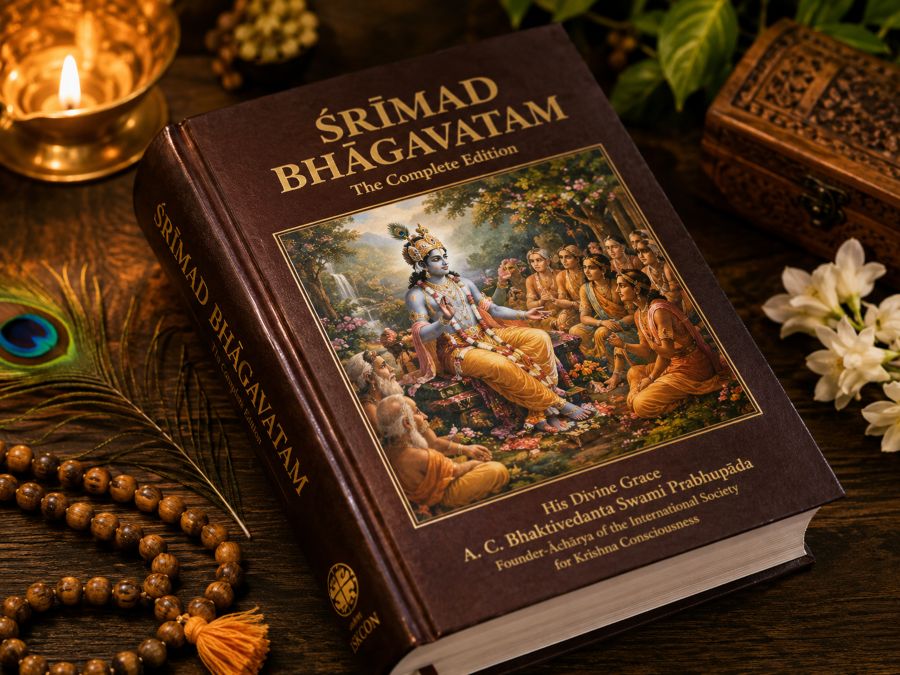
A CEO burns out after twenty years of relentless ambition. A university student quietly battles anxiety despite being surrounded by opportunities. A successful content creator stares at millions of views and still feels emotionally hollow. Somewhere else, a retired professor begins reading an ancient Sanskrit text out of curiosity and unexpectedly finds answers modern philosophy never fully gave him.
Strange pattern, isn’t it?
People from completely different worlds are arriving at the same place: the Srimad Bhagavatam.
Inside the first moments of discovering authentic editions through the ISKCON Mayapur Store, many readers realize this is not simply another spiritual book stacked beside motivational literature and trendy mindfulness guides. The Srimad Bhagavatam feels different because it speaks directly to the deepest human questions most people spend years trying to avoid.
Why am I never fully satisfied?
Why does success fade so quickly?
Why do intelligent people still suffer emotionally?
What actually creates peace?
For centuries, the Srimad Bhagavatam remained treasured primarily within spiritual traditions. Now something unusual is happening. Entrepreneurs, psychologists, intellectuals, artists, researchers, yoga practitioners, and ordinary readers are returning to it with fresh seriousness.
Not because it is fashionable.
Because modern life is exposing emotional cracks that technology cannot repair.
And the Srimad Bhagavatam addresses those cracks with startling depth.
People Have More Information Than Ever — Yet Feel More Lost
Humanity has mastered access.
Information arrives instantly.
Entertainment never stops.
Advice is endless.
Yet emotional confusion keeps rising.
That contradiction matters.
The modern world solved many external problems while quietly intensifying internal instability. People can communicate globally while feeling personally disconnected. They can build digital identities while losing touch with themselves.
The Srimad Bhagavatam becomes powerful in this environment because it does not merely provide information. It explains the structure of consciousness itself.
That is rare.
Most books teach:
- how to achieve
- how to optimize
- how to compete
- how to recover from stress
The Srimad Bhagavatam asks a far deeper question:
What is the purpose of the human experience beyond survival and stimulation?
Thought leaders are rediscovering the text because eventually every intelligent person reaches the limitation of material achievement alone.
Success solves certain problems.
It does not automatically solve emptiness.
The Bhagavatam Understands the Human Mind With Surprising Precision
One reason readers become emotionally attached to the Srimad Bhagavatam is because it understands psychological behavior in ways that feel uncannily modern.
The text explores:
- attachment
- insecurity
- ego
- fear
- envy
- addiction
- grief
- desire
- loneliness
- pride
- emotional illusion
And it does so without sounding clinically detached.
The stories feel alive because the characters struggle exactly the way humans still struggle now.
King Parikshit faces mortality.
Dhruva seeks validation after rejection.
Ajamila loses himself through unhealthy attraction.
Kunti learns resilience through suffering.
These are not distant mythological cartoons. They are emotional case studies.
A thoughtful reader quickly realizes something important:
Human technology changed dramatically. Human psychology did not.
The same emotional storms still exist beneath modern clothing and digital lifestyles.
Why Intellectuals Are Taking the Srimad Bhagavatam Seriously Again
There was a period when many educated circles dismissed spiritual texts as primitive or irrational. That confidence is weakening now.
Not because science failed.
Because material explanations alone often feel incomplete.
The Srimad Bhagavatam attracts intellectual readers because it does not demand blind emotional surrender. It presents philosophical arguments about consciousness, identity, ethics, mortality, suffering, and the nature of reality itself.
Many thinkers are especially drawn to one central idea:
You are not merely the body.
At first glance, that may sound theological. But philosophically, it creates fascinating questions.
If identity is entirely physical:
- why do humans seek meaning beyond survival?
- why does consciousness feel subjectively unique?
- why does emotional fulfillment remain elusive despite material progress?
The Srimad Bhagavatam approaches consciousness as fundamentally spiritual rather than accidental biological chemistry.
That perspective completely changes how suffering is understood.
Burnout Is Driving People Toward Ancient Wisdom
Modern achievement culture quietly exhausted millions of people.
The pressure never ends:
- perform more
- produce more
- consume more
- compete more
- display more
Many high performers eventually discover something uncomfortable:
The finish line keeps moving.
The Srimad Bhagavatam speaks directly to this condition. It explains that material desire expands endlessly when disconnected from spiritual grounding.
This insight feels painfully relevant today.
A person achieves one goal, experiences temporary excitement, then immediately searches for another target. The cycle repeats for decades.
The Bhagavatam describes this as the restless nature of uncontrolled desire. Not evil desire. Unanchored desire.
That distinction matters.
The text does not demonize ambition. It questions ambition without inner clarity.
Readers Are Tired of Shallow Positivity
A major reason the Srimad Bhagavatam is gaining renewed attention is because many people have grown skeptical of surface-level self-help culture.
“Just think positive.”
“Manifest success.”
“Stay motivated.”
“Believe in yourself.”
These ideas may create temporary emotional boosts, but they often collapse during real suffering.
The Srimad Bhagavatam does not offer artificial optimism. It speaks honestly about:
- death
- pain
- disappointment
- attachment
- illusion
- emotional struggle
Oddly enough, that honesty feels comforting.
Readers trust books that acknowledge reality rather than emotionally decorating it.
The Bhagavatam’s wisdom feels durable because it was not written to entertain fragile attention spans. It was written to confront the deepest existential questions directly.
Social Media Created a Crisis of Identity
The modern world turned identity into performance.
People carefully construct digital versions of themselves while privately battling insecurity, anxiety, and emotional exhaustion.
The Srimad Bhagavatam diagnosed this long ago through its discussions of false ego.
False ego does not simply mean arrogance. It means misidentification — believing temporary labels define the self completely.
Examples include:
- status obsession
- image dependence
- comparison addiction
- external validation hunger
- emotional instability tied to public opinion
Sound familiar?
The Bhagavatam explains that when identity becomes dependent on unstable external conditions, suffering becomes inevitable.
That insight feels almost prophetic in the age of algorithm-driven validation.
The Bhagavatam Does Not Reject Modern Life
This is where many newcomers become surprised.
The Srimad Bhagavatam is not asking people to escape civilization and disappear into caves. It is asking them to understand consciousness while living responsibly.
That balance makes the text especially attractive to thoughtful modern readers.
It teaches:
- disciplined living
- meaningful relationships
- emotional awareness
- responsibility
- compassion
- ethical action
- spiritual intelligence
The ideal person in the Bhagavatam is not passive or emotionally numb.
He or she becomes internally stable while remaining active in the world.
That model feels increasingly attractive in a culture dominated by emotional overreaction and mental exhaustion.
Why Spiritual Seekers Feel Emotionally Seen by the Bhagavatam
Many spiritual seekers spend years moving through systems that feel incomplete.
Some paths become overly commercialized.
Some become intellectually dry.
Some reduce spirituality into trendy aesthetics.
Some avoid difficult truths entirely.
The Srimad Bhagavatam feels different because it combines:
- philosophy
- psychology
- devotion
- ethics
- metaphysics
- storytelling
- emotional realism
Readers often describe feeling “seen” by the text because it addresses hidden emotional experiences people rarely discuss openly.
The fear of aging.
The fear of insignificance.
The frustration of unfulfilled desire.
The exhaustion of pretending to be happy.
The Bhagavatam refuses to reduce human life into productivity metrics and temporary pleasure cycles.
That honesty creates emotional trust.
The Stories Stay With People for Years
Most modern content disappears quickly from memory.
A viral post survives for hours.
A trending video lasts days.
But the narratives inside the Srimad Bhagavatam stay in the mind for years because they operate symbolically, emotionally, and philosophically at the same time.
Dhruva’s determination.
Prahlada’s fearlessness.
Parikshit’s acceptance of mortality.
Rishabhadeva’s teachings.
The conversations between sages and kings.
These stories continue unfolding psychologically long after reading them.
A mature reader often revisits the same passage years later and discovers completely new meaning.
That is a sign of literary and philosophical depth.
Why Leaders Are Quietly Reading Ancient Spiritual Texts
An interesting shift is happening among thoughtful leaders.
Many are beginning to realize that external management means little without internal mastery.
A person may lead:
- companies
- institutions
- audiences
- political systems
while remaining personally chaotic.
The Srimad Bhagavatam repeatedly emphasizes self-governance before external governance.
Control the mind.
Control impulses.
Develop clarity.
Understand ego.
Act responsibly.
These principles are psychologically timeless.
Leadership without self-awareness eventually becomes destructive, no matter how intelligent the leader appears externally.
This explains why many executives, educators, and thinkers quietly turn toward spiritual literature after years of worldly success.
Not out of weakness.
Out of exhaustion with superficiality.
The Bhagavatam Makes Readers Slow Down and Think
One reason modern readers initially struggle with the Srimad Bhagavatam is also one of its greatest strengths:
It cannot be consumed passively.
The text demands reflection.
You cannot skim profound existential discussions the same way you skim social media content. The Bhagavatam forces the mind to slow down, observe itself, and confront uncomfortable truths.
At first, this feels mentally demanding.
Then it becomes deeply refreshing.
Many readers eventually realize that constant distraction weakened their ability to think deeply at all.
The Bhagavatam rebuilds contemplative attention.
That alone makes it valuable in the digital age.
Anxiety, Mortality, and the Search for Meaning
Modern society became highly skilled at distracting people from mortality.
Entertainment is endless.
Noise is constant.
Silence is avoided.
Yet anxiety remains widespread because human beings instinctively know life is temporary.
The Srimad Bhagavatam approaches mortality differently. It does not encourage panic or nihilism. It encourages preparation through understanding consciousness.
King Parikshit’s story becomes especially important here.
After learning he has only seven days left to live, he does not waste time pretending death is avoidable. He asks the most intelligent question possible:
“What should a human being hear, remember, and do at the time of death?”
That question transforms the entire narrative.
The Bhagavatam suggests that the quality of consciousness matters more than external possession.
For many readers, this perspective changes priorities permanently.
Why Younger Readers Are Becoming Curious Again
Interestingly, younger audiences are also rediscovering the Srimad Bhagavatam.
Not always through religion first.
Often through curiosity.
Many younger readers feel disappointed by:
- hyper-consumer culture
- performative activism
- shallow influencer spirituality
- emotional instability online
- endless comparison cycles
They are searching for something emotionally substantial.
The Bhagavatam offers depth without pretending life is simple. It acknowledges suffering while presenting the possibility of inner transformation.
That balance resonates strongly with thoughtful younger readers tired of artificial positivity and digital noise.
The Bhagavatam Explains Why Pleasure Alone Never Satisfies
One of the text’s most psychologically powerful observations is that pleasure and fulfillment are not identical.
Modern systems often confuse the two.
Pleasure is temporary stimulation.
Fulfillment creates lasting internal meaning.
The Srimad Bhagavatam repeatedly shows characters achieving power, wealth, sensual enjoyment, and recognition while remaining internally dissatisfied.
That pattern feels remarkably modern.
People today can access more stimulation than any previous generation and still experience:
- anxiety
- depression
- emptiness
- emotional numbness
- loneliness
The Bhagavatam argues that the soul seeks something deeper than temporary sensory excitement.
Whether one interprets that spiritually or philosophically, the emotional insight remains compelling.
Why the Srimad Bhagavatam Still Feels Alive
Many ancient books feel trapped in history.
The Srimad Bhagavatam does not.
Its emotional intelligence keeps it alive.
The fears inside it are still human fears.
The desires are still human desires.
The emotional conflicts remain recognizable.
A thoughtful reader does not merely study the Bhagavatam. The Bhagavatam studies the reader back.
That experience creates lasting impact.
You begin noticing:
- your own ego patterns
- attachment cycles
- emotional reactions
- hidden insecurities
- restless desires
The text becomes less like literature and more like a mirror.
The Real Reason People Keep Returning to It
At its core, the Srimad Bhagavatam offers something increasingly rare:
Depth.
Not entertainment disguised as wisdom.
Not empty intellectualism.
Not spiritual branding.
Real depth.
It respects the reader enough to ask difficult questions about identity, purpose, consciousness, suffering, and the nature of happiness itself.
That is why thinkers, spiritual seekers, and ordinary readers continue rediscovering it generation after generation.
Because beneath all the philosophy and stories, the Srimad Bhagavatam speaks to a silent human longing modern culture still struggles to satisfy:
The desire to understand who we truly are — beyond achievement, beyond fear, beyond temporary identity, and beyond the endless noise of the external world.


