Why Every Kirtan and Carnatic Performance Feels Incomplete Without a Mridangam
Close your eyes for a moment and imagine a kirtan without it.
Just voices. Maybe a harmonium. The clap of hands. It’s fine — even beautiful in its own way. But something is missing. Something deep and physical. Something that doesn’t just reach your ears but moves through your chest, your spine, the soles of your feet.
That’s the mridangam’s absence you’re feeling.
Now add it back. That first thom — low, resonant, rolling like distant thunder — and suddenly the entire sonic landscape changes. The voices have a foundation. The rhythm has a heartbeat. The room has a pulse.
If you’ve ever wondered why serious kirtan groups and every Carnatic classical concert insist on having a mridangam player, this article will answer that question fully. And if you’re thinking about sourcing an authentic instrument — places like the ISKCON Mayapur Store Mridangam section are worth exploring for quality instruments rooted in devotional tradition.
But first, let’s understand why this drum is truly irreplaceable.
The Mridangam Isn’t Just Percussion — It’s Architecture
Here’s the thing most people misunderstand about the mridangam’s role in performance.
They think of it as keeping time. Like a metronome with style. Something that runs in the background while the “real” music happens up front.
That couldn’t be more wrong.
The mridangam is structural. It’s the architecture that everything else is built on. Remove it and the music doesn’t just lose rhythm — it loses its shape. The phrases don’t land the same way. The emotional arcs collapse. The silences between notes stop meaning anything.
A skilled mridangam player isn’t accompanying the music. They’re co-creating it in real time.
In Carnatic classical music, this is understood so deeply that the mridangam player is never called an “accompanist” in the way Western music uses that word. The term is pakka vaadyam — the instrument that makes things firm, solid, complete. That single term tells you everything about the function.
What Makes the Mridangam Acoustically Unique
Two Voices, One Instrument
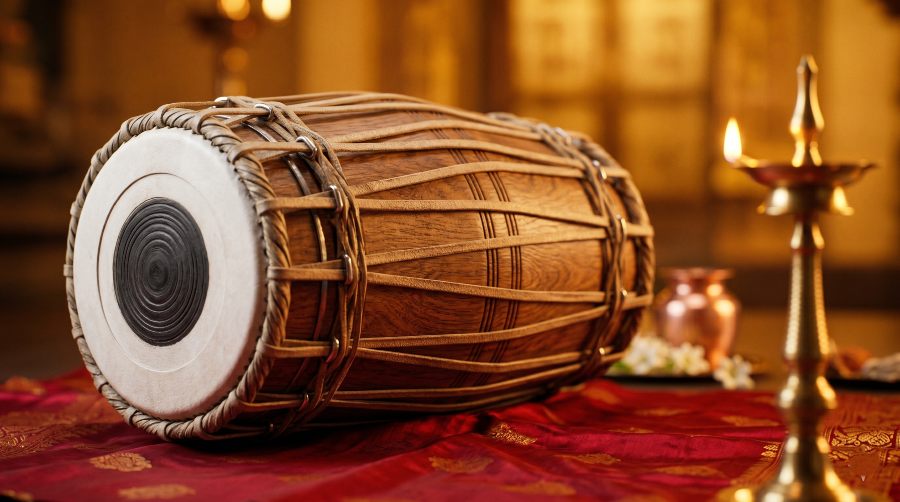
The mridangam speaks in two voices simultaneously. The right head — smaller, with its distinctive black tuning paste — produces crisp, bright, almost melodic tones. The left head — larger, loaded with semolina paste before performance — produces deep, warm bass tones that can feel almost physical in an enclosed space.
No other single percussion instrument in Indian classical music can do both things at once with this range and precision.
The tabla — brilliant as it is — achieves a similar duality through two separate drums played together. The mridangam does it in one body, one instrument, two hands working across a unified acoustic chamber.
This matters enormously in performance. The bass and treble aren’t just happening simultaneously — they’re in constant conversation, answering each other, building tension and release within the space of a single rhythmic phrase.
The Tuned Right Head
The black circular patch on the right head — called karanai or soru — is made from a paste of rice, iron filings, and manganese powder, applied in careful layers over weeks and ground to precise thickness.
This patch fundamentally transforms the acoustics. Without it, the right head would produce a generic drum tone. With it, the overtone structure becomes complex and musical — almost pitched — allowing the mridangam to track the melodic content of the music, not just its rhythm.
This is why you’ll notice that mridangam players tune their instrument to match the tonic pitch (shruti) of the performer they’re accompanying. The mridangam doesn’t just keep time in a key — it inhabits the key.
Resonance That Fills a Room
Even in large concert halls, before the era of microphones and amplification, the mridangam projected powerfully. The jackwood body, the precise construction of the barrel, the tension of the lacing — everything is optimized for natural acoustic projection.
In kirtan settings — whether an intimate room in a temple or a large outdoor festival — this natural resonance becomes almost magical. The mridangam doesn’t need to be loud to be felt. It simply carries in a way that synthesized sounds and most other percussion instruments don’t.
The Mridangam in Kirtan: A Sacred Conversation
What Kirtan Actually Demands
Kirtan is call-and-response devotional singing. The lead singer — the kirtaniya — calls out a phrase. The group responds. This back-and-forth builds over time, gradually increasing in energy, intensity, and spiritual heat until it reaches a breaking point of ecstasy.
This structure places very specific demands on the accompanying percussion.
The mridangam player must:
- Hold the foundation steady during the call, so the response lands powerfully
- Build energy subtly without rushing the tempo prematurely
- Read the kirtaniya’s intentions — when they’re about to lift the group to a new level, the mridangam must be ready to match and amplify
- Know when to hold back — often, the most powerful moment in a kirtan is a sudden drop in percussion intensity that creates space for voices to soar
This is not mechanical time-keeping. It’s empathic musical conversation.
The Gaudiya Vaishnava Tradition
In the tradition of Gaudiya Vaishnavism — the devotional tradition of Sri Chaitanya Mahaprabhu — kirtan with mridangam has a specific theological weight.
Chaitanya Mahaprabhu himself is described in the texts as dancing in ecstasy to the sound of mridangam and karatalas (hand cymbals). The Chaitanya Bhagavata and Chaitanya Charitamrita are filled with descriptions of sankirtan parties moving through the streets of Navadvipa and Puri with mridangam players setting the rhythmic fire.
This means the mridangam in kirtan isn’t just a musical choice. It’s a replication of a sacred historical event. When devotees sing Hare Krishna with mridangam, they are consciously recreating the sankirtan movement that Chaitanya Mahaprabhu ignited 500 years ago.
That’s a different kind of instrument significance than most percussion instruments carry.
The Five Hundred Year Kirtan Lineage
The mridangam’s role in kirtan can be traced in an unbroken line back to 16th-century Bengal. In the Navadvipa of Chaitanya’s time, the streets would fill with kirtaniyas, and the mridangam was always at the center of the sound.
The specific rhythms used in Vaishnava kirtan — many of them preserved and transmitted through oral tradition — were developed in direct response to the ecstatic nature of this practice. These aren’t generic drum patterns. They’re specifically designed to support the call-and-response structure, to build energy along a devotional arc, and to create the specific kind of bhava (emotional state) that kirtan aims for.
A mridangam player who has been trained in this tradition brings all five centuries of that knowledge into the room with them.
The Mridangam in Carnatic Classical Music: The Heartbeat of a Civilization
Why Carnatic Music Cannot Function Without It
Carnatic music is built on talam — rhythmic cycles of specific beat counts that organize every piece of music. The mridangam player is the living embodiment of talam in performance.
But here’s what’s crucial: the mridangam player isn’t just keeping the tala. They’re interpreting it. They’re finding the inner rhythmic life of the tala, the way certain beats want to be accented differently, the way a seven-beat cycle feels different from a six-beat cycle not just numerically but emotionally.
Great Carnatic composers wrote their pieces with specific talas because those talas have specific characters. The mridangam player’s job is to make that character audible, tangible, felt.
Without the mridangam, a Carnatic piece is like a building without its structural core — the facade might still be beautiful, but you can feel that something essential is missing.
The Tani Avartanam: When the Drum Takes the Stage
If you’ve attended a full-length Carnatic concert, you know this moment.
The vocalist or instrumentalist finishes their elaboration of the main composition. There’s a pause. And then — the mridangam player begins.
The tani avartanam is the percussion solo that caps a major piece in Carnatic performance. It can last anywhere from ten minutes to forty-five minutes in the hands of a great player. It is, without exaggeration, one of the most sophisticated forms of rhythmic improvisation anywhere in the world’s musical traditions.
The mridangam player works within the specific tala of the piece, but within that cycle they build entire rhythmic narratives — introducing patterns, developing them, combining them in increasingly complex ways, creating tension through polyrhythm and releasing it with resolutions that land precisely on the sam (first beat).
A great tani avartanam leaves audiences stunned. Not because it’s loud or showy, but because it reveals a mathematical and musical intelligence operating at a level that seems almost superhuman.
No other instrument in the Carnatic tradition can carry this solo responsibility. The mridangam is uniquely equipped for it by both its acoustic range and its centuries of developed technique.
The Chemistry Between Vocalist and Mridangam Player
Ask any great Carnatic vocalist about their relationship with their mridangam accompanist and they’ll almost invariably use words like chemistry, trust, conversation, partnership.
This isn’t metaphor. It’s literal description of what happens in performance.
A vocalist might choose to extend a phrase by half a beat — and the mridangam player needs to be there, having anticipated this choice from subtle cues in the previous phrase. The vocalist might decide to drop suddenly to a pianissimo — and the mridangam player’s response in that moment determines whether the effect lands or falls flat.
This level of musical communication only develops through years of performing together and through a shared understanding of Carnatic aesthetics so deep it becomes instinctual.
The mridangam player in a Carnatic concert isn’t a hired hand. They’re a co-author of the musical experience.
Comparing the Mridangam to Other Drums in Indian Music
People often wonder: couldn’t you use a tabla? Or a dholak? What about electronic percussion?
Each of these questions deserves a direct answer.
Mridangam vs. Tabla
The tabla is the percussion instrument of Hindustani classical music — North India’s classical tradition. It’s a pair of drums played together, producing a wide range of tones.
In Hindustani music, the tabla is as essential and sophisticated as the mridangam is in Carnatic music. They’re both extraordinary instruments. But they’re not interchangeable.
The mridangam has a single-body construction that gives it a fundamentally different resonance and projection profile. Its technique — the specific strokes, the way patterns are constructed and combined — is deeply embedded in Carnatic compositional structures. Using a tabla for Carnatic music would be like using a French horn where a violin is called for — technically both are musical instruments, but they’re built for different sonic and structural purposes.
In kirtan traditions, however, both mridangam and tabla appear. Gaudiya Vaishnava kirtan historically uses mridangam; certain North Indian kirtan traditions use tabla. Neither is wrong — they reflect the regional and lineage-specific contexts of each tradition.
Mridangam vs. Dholak
The dholak is a folk drum — wonderful for wedding music, bhangra, folk songs. It’s simpler in construction, louder, and designed for outdoor festival contexts.
It cannot produce the precise, nuanced vocabulary of strokes that the mridangam has. It cannot track pitch. It cannot carry the structural weight that classical music demands.
Using a dholak in a serious Carnatic performance would be a category error — like asking a folk singer to perform classical opera. Different tools, different purposes.
Mridangam vs. Electronic Percussion
This question comes up as live music increasingly incorporates electronic elements.
The short answer: electronic percussion can approximate the sound of a mridangam. It cannot approximate the experience.
A live mridangam player responds. They listen. They make micro-adjustments in the moment. They create a different emotional arc every night. The imperfection, the human presence, the risk of live improvisation — these are features, not bugs.
In kirtan especially, the devotional energy that builds in a room is generated by living beings in real relationship with each other and with the music. A drum machine doesn’t participate in that. It only produces sound.
What to Look for in a Quality Mridangam
If you’re a kirtan group, a Carnatic musician, or a serious practitioner looking to acquire an instrument, the differences in quality matter enormously.
Wood Quality and Seasoning
The jackwood body should be from mature, properly seasoned timber. Unseasoned wood warps and affects tuning stability. Ask about the wood source and how long it was seasoned before being worked.
The Right Head Patch
The black karanai patch on the right head is the soul of the instrument’s sound. It should be smooth, even, and well-centered. If it’s uneven or cracked, the overtone production will be inconsistent.
A good instrument maker — and there are only a handful of truly excellent ones — will have spent decades perfecting this particular aspect of construction.
The Lacing and Tuning Pegs
Leather lacing should be thick, even, and properly tensioned. The wooden tuning blocks should be snug but adjustable. An instrument that won’t hold tuning is an instrument that will frustrate you in performance.
Where to Source a Quality Instrument
For devotees and kirtan practitioners, instruments sourced through established Vaishnava institutions often have a quality assurance that comes from decades of institutional use and feedback. These instruments are chosen specifically for use in devotional contexts — which means they’ve been tested in exactly the conditions you’ll be using them in.
For Carnatic musicians, established instrument makers in Chennai, Palakkad, and Thiruvananthapuram are the traditional sources. The best makers have waiting lists — which tells you something about both their quality and their reputation.
Learning to Play: What the Journey Actually Looks Like
The First Six Months
The early months of mridangam study are humbling. You’re learning to produce clean, consistent individual strokes — the ta, the thom, the dhin. Each stroke requires a very specific combination of finger position, wrist movement, and pressure. Getting even one stroke consistently clean takes weeks of daily practice.
Your fingers will hurt. Calluses will form. Your wrist will ache in a new and specific way. This is normal.
What you’re doing in this phase is building muscle memory so deep that the strokes eventually happen without conscious effort — freeing your mind to focus on rhythm, expression, and musical communication.
The First Two Years
By the end of the first two years with a good teacher, you’ll have covered the basic strokes, the primary exercises (alankarams), and several of the main talas. You’ll be able to maintain a steady tempo through a full piece. You might even be beginning simple accompaniment.
This is the phase where the instrument starts to feel like yours.
The Long Game
Professional-level mridangam playing takes ten to fifteen years of serious study. Some players would say it takes a lifetime.
This isn’t discouraging — it’s clarifying. The mridangam rewards long-term commitment with a depth of musical capability that few other instruments can match. Players in their sixties and seventies who have been playing since childhood bring a quality of presence and musical intelligence to their performances that simply cannot be rushed.
The Mridangam’s Place in the Modern World
Crossing Into Fusion
Contemporary musicians have taken the mridangam into jazz, electronic music, world fusion, and film scores. Artists like Selvaganesh, Ustad Zakir Hussain’s collaborations with Carnatic percussionists, and various world music ensembles have demonstrated that the mridangam’s vocabulary translates across genre boundaries with surprising grace.
This isn’t dilution — it’s testimony. An instrument only crosses successfully into new contexts when its fundamental sonic and expressive vocabulary is rich enough to have something to offer those contexts.
The Global Kirtan Movement
Kirtan has traveled far from its origins in 16th-century Bengal. Today, kirtan circles exist in New York, London, Berlin, Sydney, São Paulo. And wherever kirtan goes with any seriousness, the mridangam follows.
This global spread has created demand for qualified mridangam players and quality instruments worldwide — a remarkable development for an instrument that, a century ago, most of the world had never heard of.
Keeping the Tradition Alive
What makes the mridangam’s continued centrality remarkable is that it hasn’t been preserved in amber. It’s still developing. Contemporary mridangam players are pushing the boundaries of what’s technically possible while remaining rooted in the classical tradition.
That tension — between deep rootedness and living evolution — is exactly what keeps a tradition vital rather than merely historical.
Final Thoughts: The Sound That Makes Everything Complete
Come back to that image from the opening. A kirtan without mridangam. A Carnatic concert without that barrel drum sitting to the side of the stage.
Now you understand more precisely what’s missing.
It’s not just percussion. It’s the structural intelligence that makes rhythmic cycles audible and felt. It’s the devotional lineage that connects today’s performance to Chaitanya’s street kirtans five centuries ago. It’s the acoustic architecture that gives voices and melodies a foundation to build on. It’s the conversational partner that makes great performance possible.
The mridangam has been present at the center of Indian classical and devotional music for over two thousand years. It survived every musical fashion, every political upheaval, every generation that could have allowed it to fade.
It survived because it is, simply, irreplaceable.
Every kirtan that moves a room. Every Carnatic performance that leaves an audience in a different state than they arrived in. Every tani avartanam that makes people forget time exists.
The mridangam is there, making it complete.


