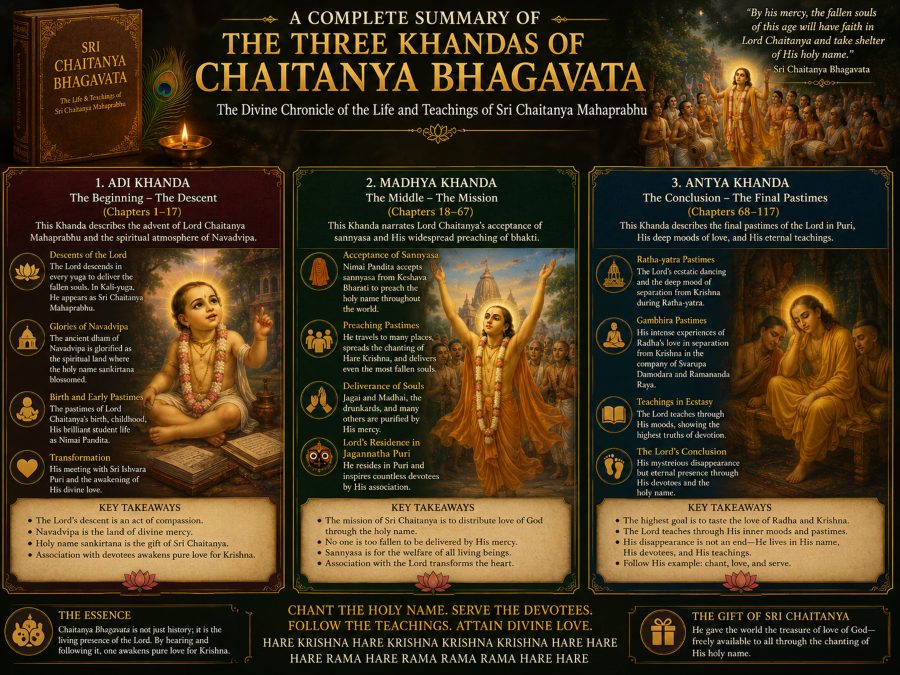
A Complete Summary of the Three Khandas of Chaitanya Bhagavata
Among the sacred texts of the Gaudiya Vaishnava tradition, few hold the emotional and historical weight of the Chaitanya Bhagavata. Written by the great saint-poet Vrindavana Das Thakura in the sixteenth century, this extraordinary Bengali text stands as the earliest and most intimate biographical account of Sri Chaitanya Mahaprabhu — the Golden Avatar of Navadvipa whose life, philosophy, and devotional revolution continue to shape millions of lives across the world today. For those who wish to study, own, or gift an authentic edition of the Chaitanya Bhagavata, the text remains one of the most indispensable treasures of the entire Vaishnava canon — not merely as literature or history, but as a living transmission of devotional consciousness that has lost none of its vitality across five centuries. Understanding its three major divisions — the Adi Khanda, the Madhya Khanda, and the Antya Khanda — is essential for any serious student of Sri Chaitanya’s life and legacy.
Why the Chaitanya Bhagavata Matters
Before entering the three khandas — sections — in detail, it is worth pausing to understand why this particular text occupies the position it does within the tradition.
The Chaitanya Bhagavata was composed by an author with a uniquely privileged position. Vrindavana Das Thakura’s mother, Narayani Devi, was the niece of Srivasa Thakura — one of Sri Chaitanya’s most intimate associates, in whose courtyard the early sankirtana gatherings took place. Vrindavana Das Thakura himself received initiation from Nityananda Prabhu, Chaitanya’s closest companion and the embodiment of divine grace. He was not reconstructing history from a distance. He was writing from within a living tradition, drawing on family memory, personal transmission, and direct devotional experience.
Sri Chaitanya himself designated Vrindavana Das Thakura as Vyasa — the compiler of divine knowledge — in recognition of the task he was carrying out. This designation is not merely honorific. It places the Chaitanya Bhagavata in the same category of authoritative spiritual literature as the Puranas themselves — not in terms of antiquity, but in terms of the quality of transmission it carries.
Krishnadasa Kaviraja Goswami, who later wrote the Chaitanya Charitamrita — the other great biography of Sri Chaitanya — explicitly acknowledged the Chaitanya Bhagavata as the foundation of his own work, offering reverence to Vrindavana Das Thakura before beginning his own account. The relationship between the two texts is one of the most beautiful examples of spiritual collaboration across time in any tradition: the Bhagavata provides the emotional and historical foundation; the Charitamrita builds the philosophical architecture upon it.
Adi Khanda: The Beginning — Divinity Wearing the Veil of Childhood
The Adi Khanda — the first section — covers the earliest portion of Sri Chaitanya’s life, from before his birth through his years as a brilliant young scholar and teacher in Navadvipa. It is, in many ways, the most intimate of the three sections, because it deals with the period when the divine identity of the figure at its center was most carefully concealed — even from those closest to him.
The Descent and the Prophecy
The Adi Khanda opens not with the birth of Sri Chaitanya but with the cosmic context of that birth. Vrindavana Das Thakura establishes, at the outset, that what is about to unfold is not an ordinary human biography. The Supreme Person — who in the age of Dvapara had appeared as the dark-complexioned Krishna — is now preparing to appear in a form suited to the age of Kali: golden-complexioned, as a devotee of his own self, carrying the gift of the divine name as the universal medicine for the suffering of the age.
This framing is essential to reading everything that follows correctly. The childhood mischief, the adolescent scholarship, the family relationships — all of it is the divine in the mode of concealment. The reader is being invited to see through the veil even as the characters within the narrative cannot.
The Birth of Nimai
Sri Chaitanya — born as Vishvambhara Mishra, affectionately called Nimai — enters the world in Navadvipa on the evening of a lunar eclipse, while the entire town is engaged in the congregational chanting of the divine name. This detail is not incidental. The tradition reads it as a divine orchestration: the Lord chose to appear at precisely the moment when the sound of his own names filled the air, as if entering the world on the vehicle of kirtana itself.
His mother Sachi Devi and father Jagannatha Mishra are portrayed with extraordinary tenderness in the Adi Khanda. They are not simply biographical figures — they are devotees of the highest order who have been chosen to serve the Lord in the most intimate of all relationships: as parents. Their confusion before the extraordinary behavior of their son, their love, their anxiety, their glimpses of recognition — all of this is rendered by Vrindavana Das Thakura with a delicacy that makes the Adi Khanda feel, at times, less like religious biography and more like the most exquisitely observed family novel.
The Mischievous Child
The early sections of Adi Khanda describe the childhood of Nimai with episodes that carry multiple layers of meaning simultaneously. On the surface, they are charming accounts of a precocious, irrepressible child who steals food from neighbors, disrupts his elders, and generally creates domestic chaos with an irresistible smile. Beneath the surface, Vrindavana Das Thakura reveals these episodes as expressions of the same divine nature that, in a different age and a different form, played on the banks of the Yamuna in Vrindavana.
The parallel with Krishna’s childhood pastimes in the Srimad Bhagavatam is deliberate and theologically precise. Chaitanya is Krishna — but Krishna appearing in a different mode, with a different purpose. Where the Vrindavana Krishna revealed his divinity selectively to his devotees, the Navadvipa Chaitanya keeps his identity more carefully veiled — because his mission requires him to demonstrate, through his own life, what the path of devotion looks like from the inside.
The Scholar of Navadvipa
As Nimai matures into adolescence and early adulthood, the Adi Khanda shifts tone considerably. The mischievous child becomes the most formidable intellect in Navadvipa — establishing a school of logic and grammar that draws students from across the region, defeating scholars in debate with a casual ease that borders on intimidation, and acquiring a reputation for brilliance that was simultaneously impressive and slightly alarming to those around him.
This period of intellectual dominance is not presented as a contradiction of Nimai’s devotional destiny but as a preparation for it. The tradition understands that the greatest teacher of the age needed to be, demonstrably, the greatest mind of the age — so that his subsequent transformation could not be dismissed as the enthusiasm of someone who had never engaged with the full rigor of Indian philosophical tradition. When Nimai later declared that bhakti — devotional love — was the supreme path, he was speaking as someone who had mastered every alternative.
Marriage and the Death of the Father
The Adi Khanda also covers Nimai’s two marriages — first to Lakshmipriya, who died young, and then to Vishnupriya, who would remain his devoted wife through the most transformative period of his life — and the death of his father Jagannatha Mishra. These personal losses are rendered with great feeling by Vrindavana Das Thakura, who understands them not as unfortunate biographical details but as the stripping away of worldly attachments that prepares the ground for the transformation to come.
The Journey to Gaya and the Return
The Adi Khanda culminates in the pivotal episode that marks the end of one life and the beginning of another: Nimai’s journey to Gaya to perform the shraddha ceremony for his deceased father, his encounter there with the Vaishnava saint Isvara Puri, and the initiation he receives — the gopala mantra — that cracks open his external personality like the shell of a ripened fruit.
When Nimai returns to Navadvipa, he is unrecognizable. The sharp logician, the confident debater, the socially dominant young scholar — all of this has dissolved. What remains is a person drowning in devotional ecstasy — weeping, laughing, calling out for Krishna, unable to complete simple sentences because waves of divine emotion keep sweeping through him. His students are bewildered. His wife is alarmed. His mother does not know what has happened to her son.
Vrindavana Das Thakura renders this transformation without explaining it away. He does not rationalize the ecstasy or domesticate it. He lets it stand in its full strangeness — because the strangeness is the point. Something that cannot be explained in ordinary human terms has entered the world through this extraordinary young man. The Adi Khanda ends with that mystery fully present, fully unresolved, demanding the reader move forward into the next section.
Madhya Khanda: The Middle — The Movement That Changed Everything
The Madhya Khanda is the largest and, in many ways, the most dramatically compelling section of the Chaitanya Bhagavata. It covers the years of Sri Chaitanya’s active public ministry in Navadvipa — the period during which the sankirtana movement was born, grew, swept through the entire region, and confronted the social and religious establishment with a force that could not be contained.
The Birth of the Sankirtana Movement
The Madhya Khanda opens with Sri Chaitanya — now transformed, now operating from a completely different center of gravity — beginning to gather devotees around the practice of congregational chanting. The initial gatherings are intimate: a group of friends and students meeting in the courtyard of Srivasa Thakura, chanting through the night, experiencing the kind of collective devotional ecstasy that none of them had previously encountered or even known was possible.
Vrindavana Das Thakura’s account of these early kirtanas is among the most vivid writing in the entire text. The sounds, the movements, the tears, the laughter, the collapse into states beyond ordinary consciousness — it reads less like a religious gathering and more like the opening of a new dimension of human experience. And that, the tradition insists, is exactly what it was.
Nityananda Prabhu Arrives
One of the most significant events described in the Madhya Khanda is the arrival of Nityananda Prabhu — Sri Chaitanya’s eternal associate, understood as an avatara of Balarama — in Navadvipa. The meeting between the two is described with extraordinary devotional intensity by Vrindavana Das Thakura, who had his own profound personal connection to Nityananda Prabhu as his spiritual master.
The arrival of Nityananda effectively doubles the force of the movement. Where Sri Chaitanya represents the sweetness and the depth of divine love, Nityananda represents the outward, rushing mercy that carries that love to whoever is in its path — including, especially, those whom no one else would approach. His presence in the Madhya Khanda tilts the entire movement toward a kind of radical inclusivity that distinguishes the Chaitanya tradition from every contemporary religious formation.
Confronting the Kazi: Religion Meets Power
Among the most dramatic episodes of the Madhya Khanda is Sri Chaitanya’s direct confrontation with the Muslim Kazi — the local administrative authority — who had banned public kirtana in Navadvipa on the grounds that it disturbed the peace and violated Islamic sensibilities.
Sri Chaitanya’s response to this ban is remarkable on multiple levels. He does not retreat. He does not compromise. He organizes what can only be described as a civil demonstration of extraordinary scale — gathering thousands of devotees for a torch-lit kirtana procession through the streets of Navadvipa that was so immense, so peaceful, and so obviously spiritually charged that the Kazi himself was disarmed. The subsequent conversation between Sri Chaitanya and the Kazi — in which the Kazi ultimately acknowledges the spiritual power of the sankirtana movement and withdraws his prohibition — is one of the great accounts of genuine interfaith encounter in Indian literary history.
Vrindavana Das Thakura handles this episode with great care, presenting Sri Chaitanya neither as a religious nationalist nor as a naive universalist but as someone whose devotional authority transcended the categories that created the conflict in the first place. The Kazi is not defeated — he is won over. And the distinction matters enormously.
The Revelation of the Universal Form
The Madhya Khanda contains several episodes in which Sri Chaitanya reveals his divine identity to intimate associates — momentarily dropping the veil of the devotee and allowing the full divine reality to become visible. These vishvarupa darshanas — visions of the universal form — are among the most theologically charged passages in the text.
Vrindavana Das Thakura’s treatment of these revelations is careful and precise. He does not sensationalize them. He presents them as experiences that the devotees who witnessed them struggled to process — experiences that were simultaneously the most real things they had ever encountered and completely beyond their capacity to fully comprehend or integrate. The response of the devotees — terror, awe, disorientation, followed by an even deeper love — mirrors, in miniature, the response of Arjuna to Krishna’s universal form in the Bhagavad Gita. The parallel is intentional.
Jagai and Madhai: The Theology of Unconditional Mercy
No summary of the Madhya Khanda would be complete without the episode of Jagai and Madhai — perhaps the single most theologically significant narrative in the entire Chaitanya Bhagavata.
Jagai and Madhai were brothers notorious throughout Navadvipa for a spectacular catalogue of vices: habitual drunkenness, violence, robbery, and behavior that had made them feared and avoided by the entire community. When Nityananda Prabhu and Haridas Thakura approached them with Sri Chaitanya’s invitation to chant the divine name, the response was physical assault. Madhai struck Nityananda Prabhu, drawing blood from his forehead.
Sri Chaitanya’s response — summoning his divine weapon, the Sudarshana chakra — is interrupted by Nityananda Prabhu himself, who intercedes for the very men who attacked him. His argument is the theological core of the entire episode: if the Lord saves only the qualified, the already-good, the spiritually advanced, what is the actual extent of his mercy? True mercy reveals its nature precisely in saving those who have no claim on it. Jagai and Madhai are the test case. And they pass — both of them ultimately transformed, surrendering to Sri Chaitanya, becoming devotees whose subsequent purity stands in dramatic contrast to their prior degradation.
Vrindavana Das Thakura understood this episode with particular depth — because his own spiritual master Nityananda Prabhu was its central actor, and because the principle it illustrates was the living foundation of his own spiritual life.
Antya Khanda: The Conclusion — Renunciation and the Beginning of the Wider Mission
The Antya Khanda — the third and final section of the Chaitanya Bhagavata — is both the briefest and the most deliberately incomplete of the three sections. This incompleteness is itself a statement — one of the most eloquent gestures of humility in the entire text.
Sri Chaitanya Takes Sannyasa
The central event of the Antya Khanda is Sri Chaitanya’s acceptance of sannyasa — the renounced order of life — from the Advaita Vedantin monk Keshava Bharati. This decision, made at approximately twenty-four years of age, sent shockwaves through the community in Navadvipa. His mother Sachi Devi’s grief is described by Vrindavana Das Thakura with heartbreaking tenderness — a mother watching her son leave the household life forever, understanding that the person she had raised was always, at some level, beyond her keeping.
Sri Chaitanya’s choice of sannyasa in the Mayavada (impersonalist) tradition — from a teacher who followed Shankara’s advaita philosophy — is one of the more provocative theological puzzles of his biography. The tradition’s understanding is that he accepted the external form of renunciation from the most respected institutional source available, without accepting the philosophical content that accompanied it. The external dignity of the sannyasa order would give his subsequent ministry a social authority that made it impossible to dismiss. He was not, after this point, a householder devotee. He was a paramahamsa sannyasi — the highest formal designation in Hindu renounced life.
The Journey to Jagannatha Puri
Following his acceptance of sannyasa, Sri Chaitanya journeyed to Jagannatha Puri — the great pilgrimage site in Odisha, home of the deity of Lord Jagannatha. The Antya Khanda covers this journey and the initial establishment of Puri as the base of Sri Chaitanya’s later ministry. The reunion with his mother Sachi Devi at Advaita Acharya’s home, the gradual adjustment of the Navadvipa community to the new reality of his renunciation, the intensification of his devotional ecstasy — all of this is covered with the same combination of intimate human detail and cosmic theological framing that characterizes the entire text.
The Deliberate Incompleteness
Here, Vrindavana Das Thakura pauses. The Antya Khanda does not cover the final eighteen years of Sri Chaitanya’s life in Puri — the years of deepening absorption in the ecstasy of divine separation, the profound philosophical conversations with Ramananda Raya and Sarvabhauma Bhattacharya, the increasingly intense and ultimately physically consuming states of devotional ecstasy that characterized the last years of his visible presence.
Vrindavana Das Thakura explained, in the closing passages of the Antya Khanda, that these final pastimes were beyond his capacity to describe — not because he lacked the information but because he lacked the spiritual qualification to do justice to their depth and intimacy. He left that territory for a future Vyasa, specifically noting that someone else would come to complete the account.
That someone was Krishnadasa Kaviraja Goswami, whose Chaitanya Charitamrita — produced decades later — took up precisely where Vrindavana Das Thakura’s humility had paused, covering the Puri years with a philosophical depth and literary grandeur that fulfills the promise of the Bhagavata‘s incompleteness.
The two texts together — the Chaitanya Bhagavata and the Chaitanya Charitamrita — form a complete picture of Sri Chaitanya’s life. But the gesture of incompleteness in the Antya Khanda remains one of the most profound acts of spiritual humility in all of Vaishnava literature. It says, in effect: I have given you everything I am qualified to give. The rest belongs to a depth I can only point toward, not enter.
Reading the Three Khandas as a Unified Whole
The three khandas of the Chaitanya Bhagavata are not three separate texts bound together for convenience. They are three movements in a single, continuously unfolding revelation.
The Adi Khanda establishes the mystery: who is this extraordinary person, and why has he come? The Madhya Khanda reveals the answer in action: this is the Supreme Person, moving through the world as a devotee, demonstrating through his own life that bhakti — devotional love — is the highest path and that divine mercy is available to everyone without exception. The Antya Khanda begins the transition from the household world to the world of full renunciation — from the local mission of Navadvipa to the universal mission that would send his teachings, through the Six Goswamis and their successors, to every corner of the world.
Each section deepens what came before it. Reading all three in sequence is an experience that rewards patience and attention with a gradually accumulating understanding — not just of Sri Chaitanya’s life, but of the nature of devotional consciousness itself and the infinite capacity of divine grace to transform whatever it touches.
Discover authentic editions of the Chaitanya Bhagavata and explore the full range of Vaishnava sacred texts and devotional resources at Mayapur Store — a trusted source for seekers and practitioners worldwide.


