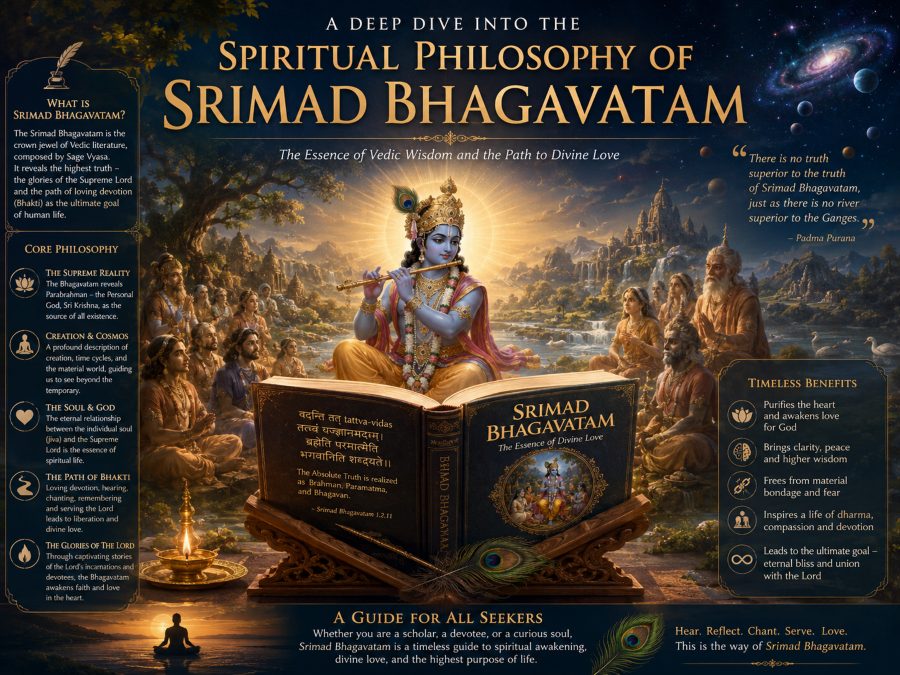
A Deep Dive into the Spiritual Philosophy of Srimad Bhagavatam
There are texts that carry information, and then there are texts that carry transformation. Most religious books fall into the first category — they teach you what to believe, how to worship, what rules to follow. But every few centuries, a scripture appears that does something far more radical. It does not merely instruct the mind; it reaches into the very core of who you are and changes it.
The Srimad Bhagavatam is that kind of scripture. Called the Amala Purana — the spotless, unblemished scripture — the Bhagavatam holds a position unlike any other text in the vast ocean of Vedic literature. It was the final composition of Sage Vyasadeva, written not out of duty or scholarship but out of personal longing — a longing to describe the Supreme in His most intimate, most beautiful form. And what emerged from that longing has been guiding sincere seekers for over five thousand years.
This article is not a summary of the Bhagavatam. You cannot summarize an ocean. What this article attempts is something more humble — to trace the central philosophical threads that run through its twelve cantos, to understand why its teachings remain as alive and relevant today as they were when Sukadeva Goswami first narrated them on the banks of the Ganga to a dying king.
The Problem That Bhagavatam Begins With
Philosophy, at its most honest, always begins with a problem. The Bhagavatam begins with one of the most direct philosophical problems ever stated in any scripture anywhere in the world.
King Parikshit has been cursed to die in seven days. He is not afraid of death the way most people are — he was a warrior, a king, a man of immense spiritual merit. But sitting on the banks of the Ganga, having renounced his kingdom and his body, he asks a question that cuts to the heart of all spiritual inquiry:
“What is the duty of a person who is about to die? What should a dying person hear, chant, remember, and do?”
This is not just a question about dying. It is a question about living. Because when you truly confront death — not as an abstraction but as a real event approaching you — everything false falls away. You are left with only what matters.
The Bhagavatam’s answer to Parikshit, delivered across seven days and twelve cantos by the sage Sukadeva Goswami, is essentially this: the only thing worth doing in this human life is to hear about, glorify, and develop love for the Supreme Personality of Godhead. Everything else — dharma, artha, kama, even moksha — is secondary. They are either stepping stones toward bhakti, or they are detours from it.
This is the philosophical foundation of the entire Bhagavatam, and it is worth sitting with, because it is far more radical than it first appears.
The Three Questions the Bhagavatam Answers
Every serious philosophical tradition tries to answer three fundamental questions. The Bhagavatam addresses all three with uncommon depth and precision.
1. What Is the Nature of the Self?
The Bhagavatam’s answer to this question is rooted in Vedantic understanding but goes beyond the advaita (non-dual) position that many modern readers are familiar with. The text presents the jiva — the individual living entity — as distinct from both the material body and the Supreme Soul. You are not your body. You are not your mind. You are not even pure undifferentiated consciousness. You are a chit-anu — a particle of consciousness — eternally individual, eternally relational, and eternally meant to be in a loving relationship with the Supreme.
This is a crucial philosophical point. The Bhagavatam does not teach that liberation means dissolution — that you merge into an undifferentiated divine ocean and cease to exist as an individual. That vision of liberation, while respectable, is described in the Bhagavatam itself as incomplete. True liberation, according to this scripture, is not the extinguishing of the self but the flowering of the self in its original, pure condition — a condition defined by joy, consciousness, and unconditional love for Krishna.
The analogy given is of a bird that has been trapped in a cage. Liberation is not the destruction of the bird. It is the opening of the cage so the bird can fly freely. The individual soul, freed from the cage of matter, does not disappear. It soars.
2. Who or What Is God?
This is where the Bhagavatam makes its boldest and most distinctive philosophical claim.
The Vedic tradition recognizes three principal ways of understanding the Absolute: as Brahman (the impersonal, all-pervading divine light), as Paramatma (the Supersoul present within every heart), and as Bhagavan (the Supreme Person, full of all divine qualities). The Bhagavatam does not dismiss the first two. It acknowledges them as genuine realizations — like seeing the sunshine, then the sun, then the sun itself with all its warmth and light and beauty.
But it argues that the fullest, richest, and most complete understanding of the Absolute is Bhagavan — the Supreme Personality of Godhead, who is identified throughout the text as Sri Krishna.
This is not a sentimental or anthropomorphic claim. The Bhagavatam builds its case philosophically. It argues that personhood — the capacity to love, to relate, to experience, to create — is not a limitation. It is the pinnacle of consciousness. An infinite being who can love and be loved is not inferior to an infinite being who simply exists. The ability to enter into relationship is not a constraint; it is the highest expression of divine freedom.
And so the Bhagavatam describes Krishna not as a tribal deity, not as one god among many, but as the original source from whom all other divine beings emanate — the svayam bhagavan, the original Godhead.
3. What Is the Purpose of Human Life?
If you know what you are (an individual soul, eternal and conscious) and you know who God is (a Supreme Person, full of beauty and love), the answer to the third question follows naturally.
The purpose of human life is to restore the broken relationship between the soul and the Supreme. The Sanskrit term for this is prema — pure, selfless, unconditional love for God. Not worship motivated by fear. Not service motivated by desire for rewards. Not devotion mixed with the hope of material benefit. But love that is its own purpose, its own reward, its own fulfillment.
The Bhagavatam calls this suddha bhakti — pure devotion. And it argues, repeatedly and from many angles, that this alone truly satisfies the deepest hunger of the human heart. Material pleasure exhausts itself. Philosophical knowledge can dry up. Power and wealth create their own anxieties. But pure love for the Divine — once awakened — only grows. It has no ceiling.
The Rasa Philosophy: God as the Beloved
One of the most philosophically sophisticated and emotionally profound contributions of the Bhagavatam to world spiritual thought is its doctrine of rasa — divine relational aesthetics.
The word rasa literally means “taste” or “juice” — the essential flavor of an experience. In the context of spiritual philosophy, it refers to the specific emotional register in which a devotee relates to God.
The Bhagavatam, particularly in its later cantos, describes five primary rasas — five ways of experiencing the Divine:
Shanta — peaceful reverence, a calm, awe-filled awareness of God’s majesty, without personal intimacy.
Dasya — the relationship of a servant to a master, defined by loving surrender and devotion, like Hanuman’s relationship with Rama.
Sakhya — friendship with God, an astonishing intimacy where the Lord is experienced not as a distant authority but as a close companion, an equal, a dear friend.
Vatsalya — parental love toward God, the most counterintuitive of all the rasas, where the devotee experiences God as a beloved child, dependent and dear. The cowherd women of Vrindavan who treated the young Krishna as their own child exemplify this rasa.
Madhurya — conjugal love, the rasa of the Gopis, representing the highest and most intimate of all divine relationships, where the soul relates to God as a beloved.
This framework is unique in the history of world religion. Most traditions maintain a strict hierarchy: God above, human below, reverence and distance the only appropriate stance. The Bhagavatam says something entirely different. It says that God, being infinite and full of love, desires intimacy with His creation. That He is not glorified most by fear but by love. That the soul’s most natural and fulfilled condition is not subordination but intimacy.
And then, remarkably, it describes in loving and specific detail how these relationships actually unfold — in the pastimes of Krishna in Vrindavan, which form the heart of the tenth canto.
The Tenth Canto: The Heart of Everything
If the Bhagavatam is an ocean, the Tenth Canto is its deepest water. More than half of all the verses in the entire scripture are contained here, and there is a reason for that.
The Tenth Canto narrates the earthly pastimes of Krishna — from His miraculous birth in a prison cell, to His childhood in the idyllic village of Vrindavan, to His encounters with demons, His friendships with cowherd boys, His relationships with the Gopi maidens, His battles against tyrants, and ultimately His establishment of a righteous kingdom in Dwarka.
But to read the Tenth Canto as mythology would be like reading a love letter as grammar. The events are real, according to the Bhagavatam’s worldview — they happened on this earth. But their deeper significance is philosophical and devotional. Each pastime is a teaching. Each encounter illuminates something about the nature of God, the nature of love, and the nature of the soul’s relationship with both.
The famous episode of the Rasa Lila — Krishna’s divine dance with the Gopis of Vrindavan — has been misunderstood and misrepresented for centuries, often by those who read it through a purely mundane lens. The Bhagavatam itself addresses this directly. It says that this pastime is not to be understood through the logic of ordinary human relations. The Gopis represent the pinnacle of devotional love — souls who have completely transcended self-interest, whose every thought, breath, and movement is oriented entirely toward Krishna. The Rasa Lila is not a story about romantic attraction. It is a story about the highest state of spiritual consciousness that any soul can achieve.
The fact that the Bhagavatam uses the language of romantic love to describe the highest spiritual reality is itself a profound philosophical statement. It says: the most intense, most all-consuming, most self-forgetful love that human beings are capable of experiencing — when purified and directed toward the Divine — becomes the very medium of liberation.
Bhakti as Both Path and Destination
One of the subtle but important philosophical distinctions the Bhagavatam makes is between bhakti as a practice and bhakti as a state of being.
Most spiritual paths have a clear separation between the journey and the destination. You practice austerity, accumulate merit, purify yourself — and eventually, at the end of all that effort, you arrive somewhere different from where you started. The path is means; liberation is the end.
The Bhagavatam presents bhakti differently. It says that even in its preliminary stages, genuine devotional practice is intrinsically valuable — not merely instrumentally so. Hearing the name of Krishna, chanting His glories, remembering His pastimes, serving His devotees — these activities are not just techniques for achieving something else. They are, in themselves, forms of liberation. The Bhagavatam uses the term mukti-pade — even in the act of bhakti, the devotee touches the ground of liberation.
This is why the Bhagavatam says that hearing even a single verse of the scripture with genuine attention can begin the process of spiritual purification. Not because the words are magic. But because the scripture is saturated with Krishna — with the presence and pastimes and qualities of the Divine — and whatever comes in sincere contact with that presence is transformed.
The Rejection of Partial Truths
The Bhagavatam is not a polite scripture. It is deeply respectful of genuine spiritual seeking in all its forms, but it is also unusually direct about the limitations of paths that stop short of pure devotion.
Karma-kanda — the performance of Vedic rituals for worldly benefit — is described as a preliminary discipline, useful for purifying one’s existence, but ultimately unsatisfying. A person attached to ritual gains merit, takes good birth, enjoys pleasant experiences — and then the merit runs out and the cycle continues.
Jnana — philosophical knowledge, the path of understanding the self as Brahman — is respected as a higher path. But the Bhagavatam notes, with characteristic frankness, that liberation into impersonal Brahman often results in a kind of spiritual stagnation. The jnani who merges into the undifferentiated absolute may “fall back” into conditioned existence if the love of God has not been awakened in their heart. Knowledge without devotion is like a lamp without oil — it can illuminate for a while, but it cannot sustain itself.
Even yogic achievement — the development of supernatural powers through meditation and breath control — is treated with a kind of gentle skepticism. The Bhagavatam tells the story of many great yogis who, having attained remarkable powers, were still ultimately drawn back to the material world by unresolved desires. Only the yogi whose meditation culminates in pure love for Krishna finds the lasting peace that yoga promises.
This is not sectarian dismissiveness. The Bhagavatam acknowledges the genuine value of all these paths. But it insists — clearly, consistently, and with considerable philosophical force — that they all find their completion in bhakti. They are rivers; bhakti is the ocean they flow into.
Srimad Bhagavatam and the Modern Seeker
It might seem that a five-thousand-year-old Sanskrit text about cowherd villages and celestial sages has little to say to a person living in the twenty-first century. This is an understandable thought, but the Bhagavatam itself anticipates it and, in a way, addresses it.
The text describes the age we are currently living in — Kali Yuga — with remarkable accuracy. It speaks of an era in which dharma is weakened, in which material values dominate, in which people are short-lived and easily distracted, in which authentic spiritual knowledge becomes rare and hard to find.
And for this age, the Bhagavatam prescribes a specific remedy: sankirtana — the congregational chanting and hearing of the names and glories of God. Not elaborate rituals. Not extended forest retreats. Not years of study under inaccessible teachers. Simply this: hear the Bhagavatam with an open heart. Chant the names of Krishna. Associate with those who love God. The path has been simplified for those who need it most.
This is, in fact, why ISKCON’s founder, His Divine Grace A.C. Bhaktivedanta Swami Prabhupada, chose to take the Bhagavatam to the West. He believed — with a certainty born of personal realization — that this scripture contained what modern humanity was desperately searching for: a vision of the self and God that was philosophically rigorous, experientially verifiable, and emotionally satisfying.
The availability of authentic BBT editions of the Srimad Bhagavatam — in English, Hindi, Bengali, and multiple other languages — through sources like the ISKCON Mayapur Store is not a trivial thing. It is the continuation of a transmission that has been flowing for thousands of years, from heart to heart, from teacher to student, from a dying king on the banks of the Ganga to anyone, anywhere in the world, willing to listen.
The Promise at the End of Listening
The Bhagavatam makes a remarkable promise. It says that a person who hears this scripture regularly, sincerely, and with the guidance of a genuine teacher will, over time, find their heart changing. Not through force of will. Not through self-punishment or extreme renunciation. But through the gentle, cumulative action of beautiful stories, profound philosophy, and the company of divine consciousness that the text carries within itself.
Lust, anger, greed — the forces that create so much suffering in human life — begin to loosen their grip. Not because you defeated them through struggle, but because something more beautiful came in and the shadows retreated on their own. The candle was lit; the darkness had nowhere to go.
This is, perhaps, the most distinctive claim of the Bhagavatam’s philosophy: that spiritual transformation happens through love and beauty, not through force. That the path to God is not a difficult climb up a steep mountain but a return home to something you always were and always loved, even when you had forgotten it completely.
Conclusion: An Open Door
The Srimad Bhagavatam is not a closed system. It does not say: “Believe exactly this, perform exactly these rituals, accept exactly these conclusions — or else.” It says, much more gently: “Come. Hear. Consider. The truth is beautiful, and it will reveal itself to a sincere heart.”
In twelve cantos, across over eighteen thousand verses, through countless stories and philosophical dialogues and devotional hymns, it returns again and again to a single point: you are loved by the Supreme. You have always been loved. And finding your way back to that love — whatever path, whatever language, whatever cultural form that takes — is the whole point of being alive.
For anyone standing at the beginning of that return journey, there is no better companion than this extraordinary scripture.


