Have You Ever Wondered Why the Bhagavad Gita Exists Inside the Mahabharata?
Imagine opening a Mahabharata Book expecting stories of kings, warriors, political intrigue, and legendary battles. Then, right in the middle of a battlefield, the action stops. A warrior drops his bow. Time almost seems to stand still. What follows is one of the most profound spiritual conversations ever recorded.
For countless readers discovering the ISKCON Mayapur Store, this moment becomes the turning point that transforms the Mahabharata from an epic tale into a timeless guide for life. Many people first encounter the Bhagavad Gita as a standalone scripture, only to learn later that it is actually a small but incredibly significant section of the Mahabharata. That realization often raises an important question: if the Bhagavad Gita is already inside the Mahabharata, why are they treated as separate books?
The answer lies in understanding their different purposes. One tells the complete story of a civilization facing moral collapse. The other captures the spiritual wisdom that explains how to live when every choice seems impossible. Together, they offer a complete picture of human life—our struggles, our relationships, our responsibilities, and our connection with the Supreme.
The Mahabharata Is More Than a Story
Many people describe the Mahabharata as an ancient Indian epic, but that description barely scratches the surface.
The Mahabharata is an encyclopedia of human nature. Every chapter explores emotions that still define our lives today:
- Love and sacrifice
- Jealousy and ambition
- Loyalty and betrayal
- Family conflict
- Political leadership
- Justice and revenge
- Spiritual awakening
Unlike fictional heroes who always make perfect decisions, the characters in the Mahabharata are deeply human. Even noble personalities struggle with difficult choices.
That honesty is one reason the Mahabharata has remained relevant for thousands of years.
It doesn’t pretend life is simple.
Instead, it asks difficult questions:
- What happens when duty hurts the people you love?
- Can a truthful person ever justify deception?
- Is winning always worth the cost?
- How should power be used?
These questions remain just as meaningful in modern families, workplaces, governments, and communities.
Why the Bhagavad Gita Appears Right Before the Great War
Arjuna’s Crisis Was Never Really About Fighting
At first glance, Arjuna appears afraid of battle.
But his hesitation runs much deeper.
Standing between two armies, he sees teachers who shaped his childhood, cousins he grew up with, respected elders, and lifelong friends. Victory suddenly feels empty because it would come at the cost of people he loves.
His bow slips from his hands.
His confidence disappears.
His mind becomes overwhelmed with grief.
This emotional collapse creates the perfect setting for Krishna’s teachings.
The Bhagavad Gita was not delivered inside a peaceful temple or quiet forest.
It was spoken during the most intense moment imaginable.
That setting carries an important message.
Spiritual wisdom is not meant only for people who have escaped the world. It is meant for people living in the middle of confusion, responsibility, pressure, and uncertainty.
That is exactly where Arjuna finds himself.
And perhaps that is why millions of readers continue to identify with him.
The Mahabharata Provides the Context
If someone reads only the Bhagavad Gita, they receive Krishna’s teachings.
If someone reads the Mahabharata, they also understand why those teachings became necessary.
Without the surrounding narrative, many verses lose their emotional weight.
Consider just a few examples.
Bhishma’s Promise
Bhishma dedicates his life to protecting the throne.
His vow becomes legendary.
Yet that same promise later forces him to support rulers whose actions he personally disagrees with.
The Mahabharata invites readers to think carefully about whether every promise should remain unchanged forever.
Karna’s Loyalty
Karna knows that Duryodhana has serious flaws.
Even so, he refuses to abandon the friend who stood beside him when everyone else rejected him.
His loyalty is admirable.
His choices are tragic.
The Mahabharata never presents simple heroes and villains.
Instead, it reveals how good qualities can produce painful consequences when attached to the wrong causes.
Draupadi’s Humiliation
Few scenes in world literature are as emotionally powerful as Draupadi’s humiliation in the royal court.
Her suffering becomes one of the moral breaking points that drives the story toward war.
Readers witness how silence in the face of injustice can be just as damaging as committing the injustice itself.
Yudhishthira’s Truthfulness
Known for honesty, Yudhishthira eventually faces situations where absolute truth conflicts with protecting innocent lives.
The Mahabharata repeatedly asks whether morality always comes wrapped in simple answers.
Usually, it does not.
The Bhagavad Gita Focuses on the Inner Battle
While the Mahabharata spans generations and kingdoms, the Bhagavad Gita concentrates on something much smaller—but infinitely deeper.
The human heart.
Its battlefield is the mind.
Its enemies include:
- Fear
- Attachment
- Pride
- Anger
- Greed
- Doubt
- False ego
Every reader recognizes these struggles.
That is why the Gita continues speaking across cultures and centuries.
It does not require readers to become warriors.
It asks them to become honest with themselves.
Story Versus Philosophy—Or Are They Really Separate?
People often compare these books as though they belong to different categories.
That comparison misses an important point.
The Mahabharata and Bhagavad Gita depend on one another.
Think of them this way.
The Mahabharata is like watching an entire movie.
The Bhagavad Gita is the conversation that changes everything.
Without the movie, the conversation feels incomplete.
Without the conversation, the movie loses its deepest meaning.
Each enriches the other.
Krishna’s Different Roles in Both Books
One fascinating aspect of reading both texts together is seeing Krishna from different perspectives.
Inside the Mahabharata, Krishna acts as:
- Diplomat
- Friend
- Strategist
- Messenger
- Guide
- Protector
- Family member
- Peace negotiator
Readers observe Him interacting with society, solving practical problems, and influencing major historical events.
Inside the Bhagavad Gita, Krishna reveals something even greater.
He speaks not merely as Arjuna’s companion but as the Supreme Personality of Godhead, explaining:
- The eternal soul
- Karma
- Dharma
- Devotion
- Material nature
- Time
- Cosmic creation
- Liberation
These two portrayals complement each other beautifully.
One shows how divine wisdom functions in everyday life.
The other explains the eternal principles behind every action.
Why Millions Read the Bhagavad Gita Separately
A common question naturally follows.
If the Bhagavad Gita is already part of the Mahabharata, why publish it independently?
There are several practical reasons.
It Can Be Read in Days Instead of Weeks
The Mahabharata contains hundreds of thousands of verses across many volumes.
The Bhagavad Gita contains only 700 verses.
Someone seeking spiritual guidance can finish the Gita much sooner while still receiving its central teachings.
It Serves as a Daily Guide
Many readers return to the Bhagavad Gita every morning.
Its concise format makes regular study realistic.
The Mahabharata, by contrast, is often read gradually over months or even years.
It Speaks Directly to Personal Challenges
People facing career decisions, family responsibilities, emotional pain, or uncertainty often find immediate comfort in Krishna’s dialogue with Arjuna.
The teachings feel deeply personal.
Almost every reader eventually discovers a verse that seems written specifically for their own situation.
Different Audiences, One Shared Purpose
Although both books belong together, readers often approach them with different expectations.
Someone interested in history, culture, leadership, politics, and character development may begin with the Mahabharata.
Someone searching for spiritual answers may begin with the Bhagavad Gita.
Eventually, many discover that reading one naturally leads to the other.
The Mahabharata sparks curiosity.
The Bhagavad Gita answers it.
The Bhagavad Gita inspires reflection.
The Mahabharata demonstrates how those teachings unfold in real human lives.
That relationship explains why both works have remained among the most influential spiritual and literary treasures ever preserved.
Why the Mahabharata Feels Incomplete Without the Bhagavad Gita
Imagine watching a grand historical drama filled with extraordinary heroes, heartbreaking betrayals, political intrigue, and a devastating war. You witness every major event, yet one question keeps returning:
Why did these people make the choices they did?
That is exactly where the Bhagavad Gita steps in.
The Mahabharata shows what happened. The Bhagavad Gita explains why human beings struggle to act according to dharma even when they know what is right.
Without the Gita, the Mahabharata remains an unforgettable story.
With the Gita, it becomes a guide for life.
The dialogue between Krishna and Arjuna changes how readers view every event before and after the Kurukshetra War. Suddenly, the conflict is no longer just about kingdoms. It becomes a mirror reflecting the battles taking place inside every human heart.
The Mahabharata Shows Dharma in Action
One of the greatest strengths of the Mahabharata is that it refuses to present morality as black and white.
Real life rarely offers perfect choices.
Again and again, the epic places its characters in situations where every available option carries consequences.
Consider a few examples.
Bhishma
His lifelong commitment to his vow made him one of history’s greatest examples of sacrifice.
Yet that same commitment prevented him from stopping injustice when he had the authority to act.
Readers naturally ask:
Can loyalty become harmful when it supports the wrong cause?
Drona
A brilliant teacher and respected scholar, Drona devoted his life to knowledge.
Still, his attachment to status and personal honor influenced decisions that contributed to the war.
His story reminds us that wisdom alone does not guarantee spiritual maturity.
Gandhari
Out of love and solidarity, Gandhari chose to cover her eyes after marrying the blind king Dhritarashtra.
Her decision became famous for its sacrifice.
Yet it also symbolizes another lesson.
Sometimes choosing not to see uncomfortable truths allows injustice to grow.
Vidura
Among all the royal advisors, Vidura consistently spoke with honesty and integrity.
He warned against greed, hatred, and political manipulation.
His advice was ignored.
Even so, he never abandoned righteousness.
The Mahabharata teaches that success is not always measured by immediate results. Sometimes integrity itself becomes the victory.
The Bhagavad Gita Explains the Science Behind Right Action
Where the Mahabharata presents examples, the Bhagavad Gita explains the principles.
Krishna introduces ideas that remain remarkably relevant.
You Control Your Effort—Not Every Outcome
One of the Gita’s best-known teachings encourages people to focus on sincere action rather than becoming consumed by results.
This is not a call to become passive.
Instead, it promotes excellence without anxiety.
Whether someone is preparing for an examination, managing a business, raising children, or caring for aging parents, the principle remains timeless:
Do your best. Let your character define your work rather than your fear of failure.
The Soul Is Eternal
Throughout the Mahabharata, countless heroes lose kingdoms, wealth, reputation, and even their lives.
Krishna shifts Arjuna’s perspective completely.
The body changes.
The soul continues.
Understanding this idea transforms how readers interpret loss, success, aging, and even death.
Instead of encouraging hopelessness, it offers a broader perspective on existence.
Desire Without Wisdom Creates Suffering
Many of the Mahabharata’s greatest tragedies begin with uncontrolled desire.
- Duryodhana desired power.
- Shakuni desired revenge.
- Dhritarashtra desired his son’s success regardless of justice.
Each attachment produced consequences that spread far beyond the individuals involved.
Krishna explains that uncontrolled desire clouds judgment and eventually leads to anger, confusion, and poor decisions.
Modern life provides countless examples of the same pattern.
Which Book Should You Read First?
There is no universal answer because every reader arrives with different interests.
Start with the Mahabharata if you enjoy:
- Rich storytelling
- Historical narratives
- Character development
- Leadership lessons
- Family dynamics
- Political strategy
- Ancient culture
The story naturally prepares you for the Bhagavad Gita.
Start with the Bhagavad Gita if you are looking for:
- Spiritual direction
- Inner peace
- Purpose in life
- Practical wisdom
- Bhakti philosophy
- Answers to personal challenges
Many readers later return to the Mahabharata with fresh understanding.
The Ideal Approach
For many people, the most rewarding experience follows this sequence:
- Read an authentic edition of the Mahabharata.
- Study the Bhagavad Gita carefully.
- Return to the Mahabharata.
The second reading often feels entirely different because Krishna’s teachings illuminate every major event.
Lessons That Still Shape Modern Life
Although thousands of years have passed, the themes of these scriptures remain surprisingly familiar.
Leadership Requires Character
Titles alone never make someone a leader.
The Mahabharata repeatedly shows rulers who possessed authority but lacked wisdom.
Krishna demonstrates leadership through service, humility, patience, and clear vision rather than personal ambition.
Businesses, governments, schools, and families still benefit from these principles.
Families Thrive on Trust
Many conflicts in the Mahabharata began long before the first arrow was released.
Jealousy, pride, favoritism, and poor communication slowly damaged relationships over many years.
Healthy families grow through honesty, mutual respect, forgiveness, and shared values.
Success Without Ethics Rarely Lasts
Several powerful characters achieved temporary victories through manipulation.
Those victories eventually collapsed.
The message remains simple.
Integrity builds lasting success.
Dishonesty creates hidden weaknesses that eventually surface.
Inner Peace Is More Valuable Than Outer Achievement
Modern society often measures success through income, recognition, or influence.
Krishna introduces another measure.
A peaceful mind.
Without inner balance, even extraordinary achievements fail to provide lasting satisfaction.
Common Misunderstandings About These Two Scriptures
“The Bhagavad Gita Is Separate From the Mahabharata.”
It is not.
The Bhagavad Gita appears within the Bhishma Parva of the Mahabharata and forms one of its most meaningful sections.
“The Mahabharata Is Only Mythology.”
Readers approach the Mahabharata in different ways—historical, literary, philosophical, and spiritual.
Whatever perspective one takes, its enduring influence on philosophy, ethics, literature, art, and culture is undeniable.
Its value extends far beyond entertainment.
“The Bhagavad Gita Encourages Violence.”
This is one of the most common misunderstandings.
Krishna does not glorify war.
His discussion with Arjuna centers on dharma, responsibility, selfless action, and devotion to God under extraordinarily difficult circumstances.
The battlefield serves as the setting for a much deeper conversation about the human condition.
Reading These Texts Through the Lens of Bhakti
Readers interested in Bhakti discover another beautiful connection.
The Mahabharata shows Krishna interacting with devotees in many different relationships.
He protects them.
Guides them.
Encourages them.
Corrects them.
Loves them.
The Bhagavad Gita then explains why devotion stands above temporary material achievements.
Bhakti is not presented as blind belief.
It is shown as a relationship built on trust, knowledge, surrender, and loving service.
This harmony between story and philosophy makes both works exceptionally powerful when studied together.
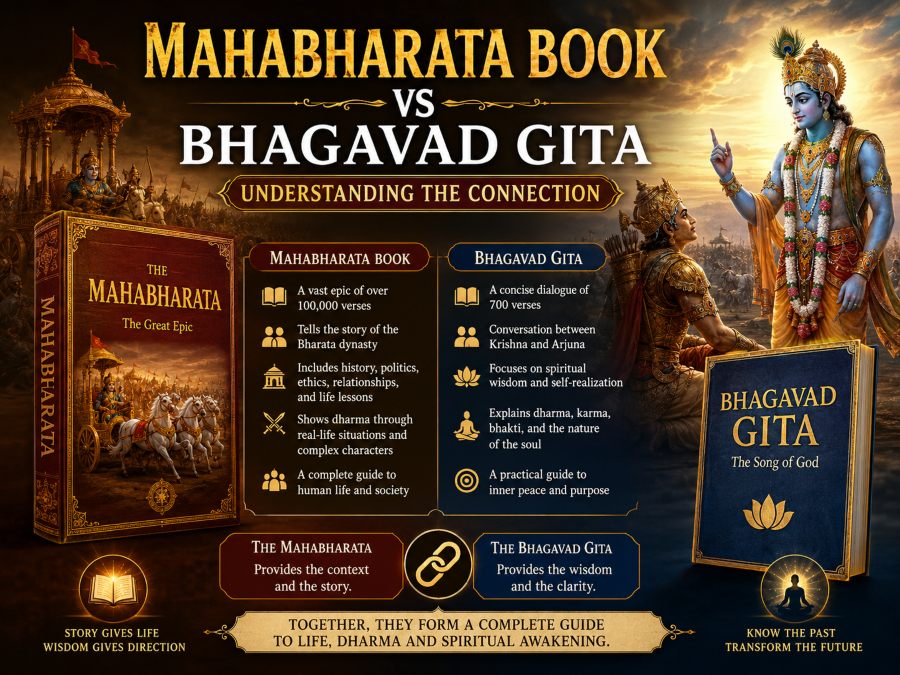
Mahabharata Book vs Bhagavad Gita: A Quick Comparison
| Feature | Mahabharata Book | Bhagavad Gita |
| Length | Massive epic | 700 verses |
| Focus | Complete narrative | Spiritual dialogue |
| Primary Theme | Dharma through life events | Dharma through philosophy |
| Main Style | Storytelling | Question-and-answer teaching |
| Central Characters | Pandavas, Kauravas, Krishna, many others | Krishna and Arjuna |
| Reading Time | Weeks or months | A few days |
| Best For | Readers who enjoy epic narratives | Readers seeking spiritual guidance |
| Relationship | Contains the Bhagavad Gita | A section within the Mahabharata |
Why Authentic Editions Matter
Not every edition presents these timeless works with the same depth and faithfulness to the original tradition.
Translations, commentary, and explanatory notes play a significant role in shaping the reader’s understanding.
An edition prepared within a respected Vaishnava tradition helps connect the historical narrative with the spiritual teachings preserved through generations of teachers. Clear explanations also make complex philosophical ideas easier to understand without losing their original meaning.
Choosing a carefully translated Mahabharata Book and Bhagavad Gita allows readers to appreciate not only the stories but also the wisdom that has inspired seekers for centuries.
Final Thoughts
Comparing the Mahabharata and the Bhagavad Gita is a little like comparing a mighty river with the spring from which its purest water flows. One carries an immense current of history, relationships, politics, sacrifice, and human emotion. The other offers the spiritual clarity that gives meaning to every part of that journey.
The Mahabharata teaches through lived experience. It reveals how ordinary people wrestle with loyalty, justice, ambition, love, and loss. The Bhagavad Gita speaks directly to the inner self, showing how wisdom, devotion, and disciplined action can transform those very struggles into opportunities for spiritual growth.
Read together, these sacred texts provide far more than knowledge. They encourage thoughtful living, compassionate leadership, stronger relationships, and a deeper connection with the Supreme. Whether you begin with the sweeping narrative of the Mahabharata or the focused teachings of the Bhagavad Gita, each naturally leads to the other, enriching your understanding with every page.
For anyone seeking both timeless storytelling and enduring spiritual guidance, studying an authentic Mahabharata Book alongside the Bhagavad Gita is one of the most rewarding journeys in world literature and spiritual philosophy.
Frequently Asked Questions
Is the Bhagavad Gita part of the Mahabharata?
Yes. The Bhagavad Gita is a sacred dialogue between Lord Krishna and Arjuna that appears in the Bhishma Parva of the Mahabharata.
Which should beginners read first?
Readers who enjoy stories often begin with the Mahabharata Book, while those seeking spiritual instruction may start with the Bhagavad Gita. Reading both provides the fullest understanding.
Why is the Bhagavad Gita published as a separate book?
Its concise format, universal teachings, and practical spiritual guidance make it ideal for individual study while remaining an integral part of the Mahabharata.
Is the Mahabharata only about war?
No. The Kurukshetra War occupies only a portion of the epic. The Mahabharata also explores ethics, family relationships, governance, devotion, philosophy, and the pursuit of dharma.
What is the biggest connection between the Mahabharata and the Bhagavad Gita?
The Mahabharata presents the real-life situations that lead to Arjuna’s crisis, while the Bhagavad Gita provides Lord Krishna’s timeless teachings on duty, devotion, and self-realization. Together, they form a complete guide to understanding both the outer challenges of life and the inner path toward spiritual wisdom.


