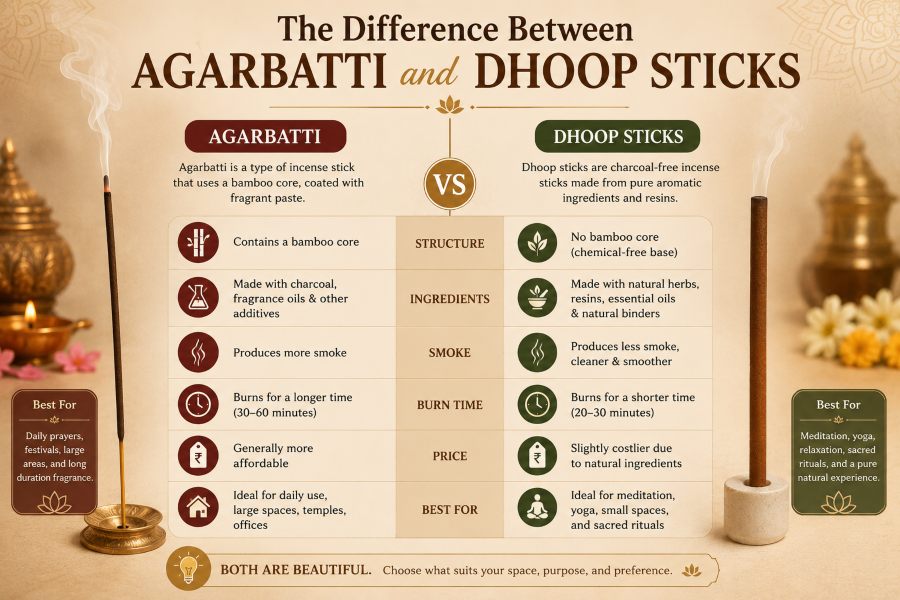
Ever picked up two packets of incense from the same shelf, both promising “sandalwood fragrance,” and wondered why one burns thin and quick while the other feels dense, slow, and almost sculptural in your hand? That difference isn’t a manufacturing accident. It’s the difference between two entirely separate incense-making traditions — agarbatti and dhoop — and most people burning them every day have no idea they’re even using two different technologies, let alone why one might suit their space better than the other. If you’ve been buying Agarbatti without ever questioning what actually makes it different from dhoop, this is the guide that finally connects the dots.
We’re not going to give you a shallow “both are nice for prayer” answer here. We’re going to look at how each one is actually made, why that changes how they burn, smell, and last, and how to decide which one genuinely fits your daily ritual instead of just grabbing whatever’s in front of you at the store.
Two Different Machines, Two Different Philosophies
Before getting into fragrance or burn time, it helps to understand that agarbatti and dhoop aren’t just “two flavors of incense.” They’re built on fundamentally different construction methods, and that construction is what drives every other difference you’ll notice.
Agarbatti is a stick incense built around a bamboo core. A thin bamboo stick gets dipped or hand-rolled in a paste of fragrant powders, natural gums, and oils, leaving a visible wooden skeleton running through the center of the finished product. Look closely at any agarbatti stick and you’ll see the bamboo poking out slightly at the unlit end.
Dhoop, on the other hand, has no bamboo core at all. It’s a solid, extruded stick or cone made entirely from a compressed paste of herbs, resins, charcoal, and binding agents. What you’re holding is the fragrant material itself, top to bottom, with nothing structural running through it.
This single construction difference explains almost everything else you’re about to read.
Why the Bamboo Core Changes Everything About How Agarbatti Burns
Because agarbatti relies on a bamboo stick as its backbone, the fragrant paste is really just a coating wrapped around that structure. This has real consequences:
- Thinner fragrance layer: since the paste is a coating rather than the entire stick, there’s simply less aromatic material per inch compared to dhoop.
- Longer, steadier burn: bamboo burns slowly and predictably, which is why agarbatti sticks typically last 35–45 minutes with a fairly even release of fragrance throughout.
- A slight woody undertone: as the bamboo core itself smolders alongside the outer paste, it can subtly influence the overall scent profile, especially toward the end of the stick.
- Easier portion control: because sticks are uniform and thin, you can predict burn time and fragrance intensity with more consistency batch to batch.
This is exactly why agarbatti became the default choice for daily household and temple use across most of India — it’s practical, predictable, and doesn’t demand constant attention.
Why Dhoop Burns Completely Differently
Dhoop skips the bamboo entirely, which means you’re burning pure aromatic material from the very first second you light it.
- Much stronger fragrance throw: since there’s no bamboo diluting the composition, dhoop tends to release a noticeably more intense fragrance, especially in the first few minutes.
- Shorter, more concentrated burn: dhoop typically burns for 15–25 minutes, which is significantly shorter than agarbatti, but the fragrance density per minute is much higher.
- No stick residue to dispose of: since there’s no bamboo skeleton, dhoop simply turns to ash completely, without a charred stick left behind.
- A denser, often smokier burn: because the entire stick is aromatic material, dhoop tends to produce thicker smoke, which some people love for its dramatic presence and others find overwhelming in smaller rooms.
If agarbatti is a slow, steady conversation, dhoop is closer to a short, intense one. Neither is better — they’re just built for different moments.
The Ingredient Story: What’s Actually Inside Each One
People often assume the ingredient list is roughly the same between the two, just shaped differently. That’s not quite accurate.
What Goes Into Agarbatti
A typical agarbatti paste includes:
- Charcoal or joss powder as a base combustion material
- Natural gums like gum arabic or jigat powder to help the paste adhere to the bamboo core
- Fragrant powders and oils — sandalwood, rose, jasmine, or synthetic equivalents depending on quality
- A binding agent to keep the coating from cracking or flaking off during handling
What Goes Into Dhoop
Dhoop paste tends to be denser and more herb-forward:
- Ground herbs and resins — often including gugal, benzoin, or other tree resins as the aromatic backbone
- Makko powder, a slow-burning binder made from the bark of certain trees, which allows the stick to hold its shape without a bamboo core
- Charcoal or saltpetre in smaller amounts, mainly to sustain combustion since there’s no bamboo assisting the burn
- Essential oils layered in for depth, rather than coated on the surface
Because dhoop’s aromatic material makes up the entire stick rather than a thin outer layer, quality differences show up more dramatically. A poorly made dhoop stick with cheap filler will smell noticeably weaker or harsher than a well-made one, whereas cheap agarbatti can sometimes hide behind the bamboo’s neutral burn.
Which One Should You Actually Use? A Practical Breakdown
This is where most guides stop at “it depends on preference,” which isn’t particularly useful. Let’s get specific.
Choose Agarbatti When You Want:
- A daily ritual that doesn’t demand attention — light it, sit down, and it burns steadily in the background for close to 40 minutes
- A gentler fragrance presence for smaller rooms, shared spaces, or offices where a strong dhoop cloud would be too much
- Portability and convenience — agarbatti sticks are easy to carry, store, and use in incense holders without extra equipment
- A predictable, repeatable experience for building the kind of consistent scent-memory association useful in daily meditation or prayer
Choose Dhoop When You Want:
- A short but intense ritual moment — ideal for evening arati, festival days, or specific ceremonial occasions where a stronger fragrance presence matters more than duration
- Deep, resin-forward fragrance — dhoop tends to carry heavier notes like gugal and benzoin far more effectively than agarbatti can
- Larger or more open spaces — dhoop’s stronger throw fills bigger rooms more effectively than a slow-burning agarbatti stick would
- A more traditional, unrefined aesthetic — many people associate dhoop’s raw, resinous form with older, more rustic devotional practices
The Smoke and Ash Difference You’ll Actually Notice
If you’ve used both side by side, you’ve probably noticed the ash behaves differently too, and this isn’t a minor cosmetic detail.
Agarbatti ash tends to curl and hold its shape for a while because the bamboo core provides structural support even as it burns. This is part of why you sometimes see long, unbroken curls of ash on a good agarbatti stick — the bamboo skeleton is holding the ash together even after combustion.
Dhoop ash crumbles more readily since there’s no internal structure holding it together. It tends to fall in smaller pieces rather than long curls, which is completely normal and not a sign of poor quality — it’s simply a function of having no bamboo core.
A Side-by-Side Comparison for Quick Reference
| Feature | Agarbatti | Dhoop |
| Core structure | Bamboo stick core | No core, solid paste |
| Typical burn time | 35–45 minutes | 15–25 minutes |
| Fragrance intensity | Moderate, steady | Strong, concentrated |
| Smoke density | Lighter | Thicker |
| Ash behavior | Curls, holds shape | Crumbles, falls freely |
| Best suited for | Daily rituals, small spaces | Ceremonial moments, larger rooms |
| Portability | High | Moderate (some varieties need a stand) |
| Ingredient sensitivity to quality | Somewhat masked by bamboo | Very noticeable — quality shows fast |
A Common Misconception Worth Clearing Up
A lot of people assume dhoop is simply a “stronger version” of agarbatti, as if they’re the same thing at different intensities. That’s not accurate, and thinking of them this way leads to disappointment. Dhoop isn’t agarbatti turned up — it’s a structurally different product with its own burn behavior, its own ideal use cases, and its own ingredient logic. Expecting dhoop to behave like a longer-lasting agarbatti, or expecting agarbatti to throw fragrance like dhoop, sets you up to be let down by both.
The smarter approach is treating them as two separate tools in the same toolbox, each suited to a different job. A carpenter doesn’t expect a chisel to do a hammer’s work. The same logic applies here.
How to Tell Which One You’re Actually Holding (If the Packaging Doesn’t Say)
Occasionally you’ll come across incense without clear labeling, especially from smaller or local producers. Here’s how to tell the difference in seconds:
- Look at the unlit end. If you see a thin wooden stick poking out, it’s agarbatti. If it’s solid aromatic material all the way through, it’s dhoop.
- Bend it gently. Agarbatti has a slight flexibility due to the bamboo core. Dhoop tends to be more rigid and can snap rather than bend.
- Check the weight. Dhoop, being solid aromatic material throughout, is usually noticeably heavier per inch than agarbatti’s thin bamboo-and-coating structure.
Storage Differences Worth Knowing
Because dhoop is denser and often resin-heavy, it can be more sensitive to heat, sometimes softening slightly in very warm conditions since resins are naturally heat-reactive. Agarbatti, protected somewhat by its bamboo structure, tends to be a little more forgiving in this regard, though both should still be kept away from direct sunlight and humidity for best results.
Bringing It All Together
The difference between agarbatti and dhoop isn’t a matter of one being more “authentic” or superior to the other — it’s a matter of construction, and that construction shapes everything from burn time to fragrance intensity to how it fits into your daily versus occasional rituals. Agarbatti gives you steady, predictable, gentle fragrance perfect for daily practice. Dhoop gives you a short, intense burst better suited to significant moments and larger spaces.
Once you understand this distinction, you stop buying incense randomly and start choosing intentionally — picking agarbatti for your everyday meditation corner and reaching for dhoop when a festival day or evening arati calls for something with more presence. That small shift in understanding turns incense from a background purchase into a deliberate part of your practice, matched to the actual moment you’re trying to create.


