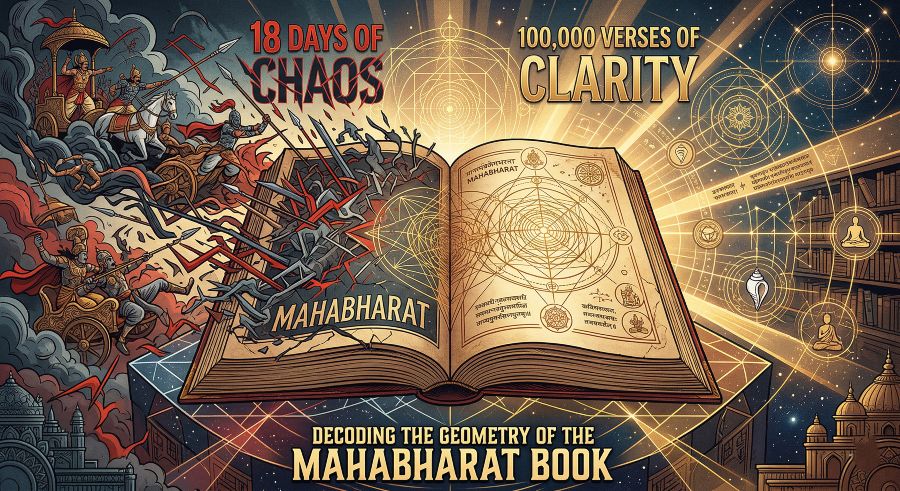
18 Days of Chaos, 100,000 Verses of Clarity: Decoding the Geometry of the Mahabharat Book
At first glance, the Mahabharata appears to be a story of war—eighteen days of relentless conflict, strategies, betrayal, and destruction. Kingdoms collapse, warriors fall, and dharma itself seems to stand on uncertain ground.
But beneath that surface lies something far more profound.
The Mahabharata is not just about chaos. It is about order hidden within chaos—a structured unfolding of human nature, cosmic law, and spiritual evolution. It is a text where every event, every dialogue, every decision contributes to a deeper pattern.
For those seeking to explore this timeless wisdom, the Mahabharat Book on Mayapur Store offers an authentic gateway into its layered meaning—preserving not just the narrative, but the philosophical geometry that defines it.
This is not merely a story.
It is a map of life itself.
The Paradox of the Mahabharata: Destruction That Reveals Truth
Why would one of the greatest spiritual texts center around a war?
Because life itself often reaches clarity only through conflict.
The Kurukshetra war represents more than a historical or mythological event. It symbolizes the inner battlefield where:
- Duty clashes with emotion
- Truth struggles against attachment
- Wisdom confronts ego
Each character is not just a person—but a psychological force.
The war becomes inevitable because these forces cannot coexist without resolution.
Understanding the “Geometry” of the Mahabharata
The term “geometry” here is not mathematical—it is structural and symbolic.
The Mahabharata is built with astonishing precision:
- 18 days of war
- 18 chapters of the Bhagavad Gita
- 18 books (Parvas)
This repetition is not accidental.
It reflects a deeper design—a cyclical pattern representing completeness, transformation, and resolution.
The Number 18: A Code of Completion
In Vedic understanding, numbers often carry symbolic meaning.
The number 18 can be broken down:
1 + 8 = 9
And 9 represents completion, fulfillment, and transcendence.
This suggests that the war, despite its destruction, leads toward a higher resolution—a restoration of dharma.
Kurukshetra: The Battlefield Within
The Mahabharata becomes truly powerful when we stop seeing it as external.
Kurukshetra exists within every individual.
- Arjuna represents the questioning mind
- Krishna represents divine guidance
- Duryodhana represents uncontrolled desire
- Bhishma represents attachment to outdated duty
The war is internal.
Every decision we make reflects this ongoing battle.
Read Also:- Krishna Janma
Krishna’s Role: The Axis of the Entire Structure
At the center of this vast epic stands Krishna—not as a warrior, but as a guide.
He does not fight.
He directs.
This positioning is crucial.
Krishna represents the unchanging center in the midst of chaos. While everything else moves—armies, emotions, strategies—he remains steady.
This is the essence of spiritual clarity.
The Bhagavad Gita: The Core Within the Chaos
Right before the war begins, time seems to pause.
In that moment, Krishna delivers the Bhagavad Gita—700 verses that contain the essence of spiritual knowledge.
This placement is intentional.
The message comes not after the war, but before it—suggesting that clarity must precede action.
Characters as Archetypes: A Psychological Blueprint
The Mahabharata is often called the “fifth Veda” because of its depth.
Each character represents a universal human tendency:
- Yudhishthira: righteousness and moral dilemma
- Bhima: strength and emotional intensity
- Arjuna: intellect and doubt
- Karna: loyalty and inner conflict
- Draupadi: dignity and divine protection
These are not distant figures.
They are reflections of ourselves.
Dharma: The Central Equation
If there is one concept that defines the Mahabharata, it is dharma.
But dharma is not simple.
It is not a fixed rule.
It is context-sensitive, dynamic, and often unclear.
This is why even great warriors struggle to understand it.
The Mahabharata does not give easy answers.
It teaches how to think, not what to think.
Strategy and Ethics: The Gray Areas of Life
One of the most fascinating aspects of the Mahabharata is its moral complexity.
Not everything is black and white.
Even the “righteous” side uses unconventional strategies.
This reflects a deeper truth:
Life is rarely ideal.
Sometimes, maintaining dharma requires navigating imperfection.
Time as a Silent Character
Time (Kala) plays a crucial role in the Mahabharata.
It is invisible, yet omnipresent.
Krishna himself declares:
“I am Time, the destroyer of worlds.”
This shifts the perspective entirely.
The war is not just human action—it is part of a larger cosmic unfolding.
The Emotional Depth: Why the Mahabharata Feels Real
Unlike many epics, the Mahabharata does not idealize its characters.
They struggle.
They doubt.
They make mistakes.
This realism is what makes it timeless.
Readers do not just observe the story—they experience it.
Lessons Hidden in the Chaos
The Mahabharata offers insights that remain relevant today:
- Success without dharma leads to destruction
- Attachment clouds judgment
- Clarity comes from inner alignment
- Guidance is essential during confusion
These lessons are not theoretical—they are practical.
Why Authentic Reading Matters
The depth of the Mahabharata cannot be captured through summaries or fragmented interpretations.
It requires:
- Authentic translation
- Proper commentary
- Contextual understanding
This is why sourcing a genuine edition is crucial for serious readers.
The Transformation of the Reader
Reading the Mahabharata is not a passive activity.
It changes the reader.
Over time, one begins to:
- Think more deeply
- Observe more carefully
- React more consciously
It sharpens awareness.
The End of the War: Not Victory, But Realization
After 18 days, the war ends.
But the victory feels heavy.
Loss is everywhere.
This is intentional.
The Mahabharata does not glorify war—it reveals its cost.
True victory lies not in defeating others, but in understanding oneself.
The Mahabharata in the Modern World
Today’s world mirrors many aspects of the Mahabharata:
- Ethical dilemmas
- Power struggles
- Emotional conflicts
This is why the text remains relevant.
It provides a framework to navigate complexity.
Final Reflection: Chaos Is Not the End
The Mahabharata begins with conflict—but it ends with clarity.
This is its greatest message.
Chaos is not the opposite of order.
It is often the path to it.
The 18 days of war represent the breaking point.
The 100,000 verses represent the understanding that follows.
And somewhere between the two lies the journey of every human being.
Conclusion: A Map Worth Exploring
The Mahabharata is not just a book.
It is:
- A philosophical guide
- A psychological mirror
- A spiritual roadmap
To read it is to engage with life at its deepest level.
And once you begin, you realize:
The war was never outside.
The answers were never far.
They were always within.


