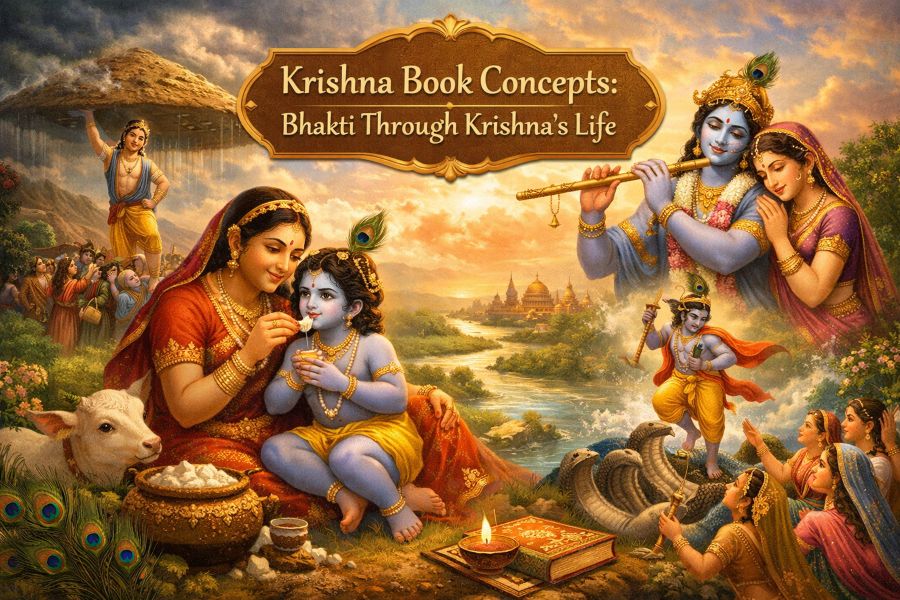
Krishna Book Concepts: Bhakti Through Krishna’s Life
For anyone trying to understand devotion in a practical, heartfelt way, Krishna Book Concepts offers a powerful doorway into the world of bhakti through the beautiful life of Lord Krishna. More than a collection of sacred stories, the Krishna Book presents a living theology of love, surrender, service, remembrance, and divine relationship. It shows that bhakti is not merely a ritual practice or a philosophical idea. It is a complete way of seeing life, shaping the heart, and awakening one’s deepest spiritual identity. Through Krishna’s childhood pastimes, His protection of devotees, His loving exchanges, and His role as the Supreme Personality of Godhead, readers encounter timeless lessons on how devotion develops and why it remains the highest path in spiritual life.
At its core, the Krishna Book helps readers understand:
- Bhakti as a personal relationship with Krishna
- Devotion through love, surrender, and remembrance
- Krishna’s life as a guide to spiritual growth
- The importance of divine protection and shelter
- The transformation of consciousness through devotional hearing
Bhakti as the Heart of Krishna’s Life
Bhakti, in its simplest and purest sense, means loving devotional service to the Supreme Lord. Yet the Krishna Book reveals that bhakti is much more than formal worship. It is a living relationship rooted in affection, trust, surrender, and constant remembrance. Krishna’s life is the perfect stage upon which this truth is displayed. Every pastime in the Krishna Book demonstrates that the Lord is not distant, abstract, or inaccessible. He enters the lives of His devotees and responds to their love in deeply personal ways.
Unlike dry spiritual approaches that focus only on liberation, logic, or renunciation, bhakti centers on relationship. Krishna does not demand love through force. He attracts it through beauty, sweetness, compassion, and divine charm. This is one of the most important concepts the Krishna Book teaches. The soul’s natural position is not to dominate, enjoy separately, or remain spiritually neutral. It is to love Krishna.
This section highlights a few central truths about bhakti:
- Bhakti is based on loving service, not mechanical ritual
- Krishna responds personally to sincere devotion
- Spiritual life reaches perfection through relationship with God
- Divine love is higher than dry intellectualism alone
The stories of Gokula, Vrindavan, Mathura, and Dvaraka all illuminate different shades of devotion. Some devotees serve Krishna as a child, some as a friend, some as a beloved, and some as the Supreme Lord. The spiritual richness of the Krishna Book lies in showing that bhakti is dynamic. It is not one-dimensional. Devotion grows according to mood, intimacy, and purity of heart.
Because of this, the Krishna Book becomes more than a narrative text. It becomes a map of divine love. Readers do not merely study Krishna’s actions; they learn how real devotion feels, how it transforms consciousness, and how the Lord reciprocates according to the sincerity of one’s love.
Krishna’s Childhood Pastimes and the Simplicity of Pure Devotion
One of the most captivating dimensions of the Krishna Book is its presentation of Krishna’s childhood pastimes. These stories are charming, playful, and full of wonder, but beneath their sweetness lies profound spiritual teaching. In Vrindavan, devotion appears in its most natural and intimate form. The residents do not love Krishna because He is God in a formal theological sense. They love Him because He is theirs. That spontaneous affection is the essence of pure bhakti.
Mother Yashoda’s care for Krishna reveals that devotion is not limited to temple rituals or scriptural recitation. Her bhakti takes the form of feeding Him, protecting Him, bathing Him, and even scolding Him. From an ordinary point of view, these are household acts. Spiritually, they are acts of perfect devotion because they are centered entirely on Krishna’s pleasure.
Krishna’s cowherd friends also show another beautiful form of devotion. They laugh with Him, play with Him, wrestle with Him, and share meals with Him without formality or fear. Their affection is free, joyful, and deeply intimate.
The childhood pastimes teach that pure devotion can be expressed through:
- Motherly affection
- Friendship and trust
- Daily loving service
- Spontaneous remembrance
- Simple, selfless attachment to Krishna
The child pastimes also teach that the Absolute Truth is not merely majestic. He is approachable and lovable. Readers often discover through these narratives that the Supreme Lord is not diminished by intimacy; rather, His greatness is revealed through His willingness to be bound by love. When Yashoda ties Krishna with rope, the scene becomes one of the most moving demonstrations of bhakti theology. The infinite Lord allows Himself to be conquered by the affection of His devotee.
This concept changes spiritual understanding completely. It tells us that love is stronger than power, and devotion reaches where intellectual effort alone cannot. In Krishna’s childhood, bhakti is shown as innocent, natural, and supremely beautiful.
The Protection of Devotees as a Central Bhakti Principle
Another major concept found throughout the Krishna Book is Krishna’s constant protection of His devotees. Again and again, dangers arise in Vrindavan and beyond, yet Krishna intervenes with effortless power. Demons appear in many forms—violent, deceptive, arrogant, and destructive—but none can overcome those who remain under Krishna’s shelter. This is not simply a dramatic pattern in sacred storytelling. It expresses a foundational principle of bhakti: the Lord personally preserves those who lovingly depend on Him.
When Putana comes disguised as a motherly figure, Krishna destroys her poisonous intention while still granting her spiritual benefit. When Trinavarta, Aghasura, Bakasura, and other demons threaten the residents of Vrindavan, Krishna protects His people without hesitation. These episodes teach that devotion does not mean an absence of challenge. Rather, it means living under divine care even amid danger.
The lifting of Govardhana Hill is one of the clearest examples of this principle. Indra’s anger unleashes torrential rains, and the people of Vrindavan face devastation. Krishna responds not with anxiety but with loving assurance. He lifts the hill like an umbrella and invites everyone to take shelter.
Important bhakti lessons from these pastimes include:
- Krishna is the ultimate protector of His devotees
- Sincere surrender brings real spiritual shelter
- Challenges in life do not cancel divine care
- Pride must give way to dependence on Krishna
- Protection is both material and spiritual in purpose
This does not mean bhakti is a contract for material comfort. Krishna protects in ways that are ultimately spiritual. Sometimes He removes obstacles, sometimes He purifies attachments, and sometimes He strengthens faith through trial. The Krishna Book helps readers understand that divine protection is always linked to spiritual progress.
For modern readers, this concept remains deeply relevant. Life is filled with uncertainty, emotional strain, and hidden threats. The Krishna Book offers a devotional answer: cultivate sincere remembrance, depend on Krishna, and understand that true safety lies in spiritual connection rather than external control.
Read Also:- Caitanya Caritamrita
Love Beyond Formal Religion: The Devotion of Vrindavan
A striking feature of the Krishna Book is that its highest devotees are often not scholars, priests, or philosophers. They are simple villagers whose entire lives revolve around Krishna. This reveals a crucial concept in bhakti tradition: spiritual perfection is not measured by social status, intellectual pride, or ritual complexity. It is measured by love.
The residents of Vrindavan embody a form of devotion that transcends formal religion without rejecting its essence. Their lives are not driven by prestige or spiritual exhibition. They do not perform devotion to be admired. They love Krishna because they cannot imagine existence without Him. This type of absorption is the real wealth of bhakti.
The gopis especially represent the most intense and selfless devotion described in the Krishna Book. Their love for Krishna is complete, uninterrupted, and beyond material comparison. Superficial readers may misunderstand these pastimes, but within bhakti theology, their devotion symbolizes the soul’s total longing for union in loving service with the Divine. Nothing selfish remains. No separate desire survives. Only Krishna’s happiness matters.
The devotion of Vrindavan teaches that true bhakti is:
- Free from selfish ambition
- Centered fully on Krishna’s happiness
- Greater than social recognition or status
- Deeply emotional yet spiritually pure
- The highest form of loving surrender
This is why the Krishna Book is spiritually transformative. It does not merely instruct the reader to “be devotional.” It shows living examples of devotion in different moods and intensities. Vrindavan stands as the ideal spiritual environment because everyone there relates to Krishna with pure affection.
This concept also corrects a common misunderstanding: bhakti is not sentimental weakness. It is the highest state of consciousness. To love Krishna without selfishness requires deep purity, freedom from ego, and total inner alignment. The apparently simple love of Vrindavan is, in truth, the summit of spiritual realization.
Krishna as Supreme God and Intimate Beloved
One of the most important theological concepts in the Krishna Book is the simultaneous revelation of Krishna as both the Supreme Personality of Godhead and the intimate beloved of His devotees. This balance is essential. If one sees Krishna only as an all-powerful God, intimacy may be lost. If one sees Him only as a charming hero, divinity may be misunderstood. The Krishna Book harmonizes both dimensions beautifully.
Throughout the narratives, Krishna performs acts impossible for any ordinary being. He subdues mighty demons, expands His form, reveals universal majesty, and guides cosmic events. These moments confirm His supreme nature. Yet even with such overwhelming divinity, He remains fully available in loving exchange. He plays the flute, jokes with His friends, accepts offerings, and allows His devotees to serve Him in personal ways.
This dual revelation helps readers understand that Krishna is:
- The Supreme Lord of all existence
- Personally present in the lives of devotees
- Full of majesty, beauty, and sweetness
- Worshipable with reverence and love
- The ultimate object of spiritual attraction
This combination is the heart of bhakti rasa. Krishna is not loved despite His supremacy, nor only because of it. He is loved because His supreme greatness includes unlimited sweetness. In Him, majesty and intimacy coexist perfectly.
This understanding has a direct effect on spiritual practice. It teaches that reverence is important, but love is the final destination. Fear may produce obedience, and knowledge may produce clarity, but only love produces the fullness of bhakti. The Krishna Book constantly pulls the reader toward this realization.
Bhakti as Transformation of Consciousness
The Krishna Book does not present devotion as a decorative addition to life. It presents bhakti as a total transformation of consciousness. To hear Krishna’s pastimes, remember His qualities, chant His names, and serve Him with sincerity is to gradually change the direction of the heart. Desire becomes purified. Ego becomes softened. Fear begins to loosen. The soul starts awakening to its original nature.
This inner transformation can be seen in every sincere devotee within Krishna’s pastimes. Their attention is centered on Krishna, and because of that, their actions become spiritualized. In bhakti, the outer act matters less than the inner offering. A simple act done for Krishna carries more spiritual value than a grand display done for self-glorification.
The Krishna Book also teaches that remembrance is powerful. Hearing about Krishna is not passive. In bhakti tradition, sacred hearing cleanses consciousness. The mind becomes shaped by what it repeatedly absorbs. When a person continually hears about Krishna’s compassion, beauty, heroism, and loving exchanges, material fixation gradually weakens.
Bhakti transforms consciousness by helping a person:
- Shift from ego to surrender
- Move from fear to faith
- Replace distraction with remembrance
- Purify desire through devotional practice
- Discover deeper spiritual identity
This is one reason the Krishna Book holds such a respected place in devotional life. It is not merely informative. It is purifying. The stories act upon the consciousness of the reader. They awaken attraction to divine life and redirect the heart from temporary fascinations toward eternal relationship.
In practical terms, this concept matters because modern life fragments attention. People are constantly pulled by fear, ambition, distraction, comparison, and restlessness. Bhakti offers another center. Krishna’s life becomes a spiritual anchor. His pastimes nourish remembrance, and remembrance nourishes devotion.
Why Krishna’s Life Still Teaches Bhakti Today
The enduring power of the Krishna Book lies in its ability to make timeless truths feel immediate and personal. Krishna’s life is not locked in the past. Its devotional concepts remain fully alive for readers today. In a world marked by anxiety, speed, emotional distance, and spiritual confusion, bhakti offers something both ancient and urgently relevant: a path of loving connection.
Krishna’s life teaches that God is not indifferent. He can be remembered, served, loved, and approached. It teaches that devotion is not for a spiritual elite. It is open to anyone whose heart is willing to soften. It teaches that divine love is not an abstract ideal but the soul’s deepest need.
That is why the Krishna Book remains meaningful today:
- It makes bhakti practical and relatable
- It teaches devotion through memorable divine pastimes
- It connects philosophy with emotion and lived experience
- It inspires spiritual reflection in modern life
- It helps readers build a personal relationship with Krishna
For this reason, the Krishna Book continues to speak across cultures and generations. Some readers come for stories and discover theology. Others come for philosophy and discover love. Many begin with curiosity and end with a changed understanding of spiritual life itself.
Bhakti through Krishna’s life is ultimately about relationship. The child Krishna, the friend Krishna, the protector Krishna, and the beloved Krishna all reveal that the highest truth is personal and reciprocal. The Lord does not merely command devotion; He invites it and responds to it.
That is the beauty of the Krishna Book. It does not simply define bhakti—it embodies it. Through every chapter, it teaches that love for Krishna is the fulfillment of knowledge, the perfection of practice, and the eternal purpose of the soul. For any sincere reader, that insight is not just inspiring. It is life-changing.


