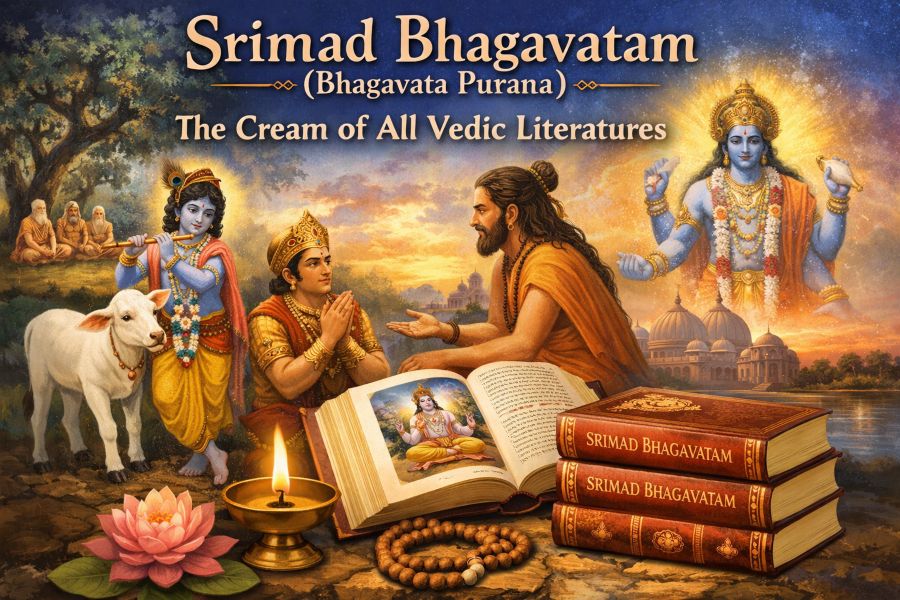
Srimad Bhagavatam (Bhagavata Purana): The Cream of All Vedic Literatures
Introduction: The Essence of Vedic Wisdom
Among the countless sacred scriptures of the Vedic tradition, Srimad Bhagavatam, also known as the Bhagavata Purana, holds a unique and exalted position. Revered by saints, scholars, and spiritual practitioners for centuries, this divine scripture is often described as the ripened fruit of the Vedic tree of knowledge. While the Vedas, Upanishads, and Puranas contain profound philosophical insights, Srimad Bhagavatam distills their essence into a devotional narrative centered on the Supreme Personality of Godhead, Lord Krishna.
For spiritual seekers who wish to explore authentic Vedic literature, many devotees today prefer to obtain genuine devotional scriptures and items from trusted devotional sources such as ISKCON Mayapur Store, which provides traditional editions of sacred texts and spiritual items connected with the Gaudiya Vaishnava tradition.
The Bhagavatam is not merely a religious book; it is a comprehensive spiritual guide that explains the nature of the soul, the purpose of human life, the workings of karma, and the path to ultimate liberation through loving devotion (bhakti). Its poetic narratives, philosophical discussions, and descriptions of divine pastimes make it both intellectually profound and spiritually transformative.
For thousands of years, sages have considered the Srimad Bhagavatam the pinnacle of all spiritual literature, capable of awakening pure devotion in the hearts of sincere readers.
Historical Origin and Compilation of Srimad Bhagavatam
The origin of Srimad Bhagavatam is deeply rooted in the ancient Vedic tradition of India. According to traditional accounts, the scripture was compiled by Srila Veda Vyasa, the legendary sage who also organized the Vedas and composed the Mahabharata.
Despite compiling vast bodies of spiritual knowledge, Vyasa still felt dissatisfied. Observing this, his spiritual master Narada Muni advised him that although he had explained dharma, karma, and philosophy, he had not fully glorified the Supreme Lord’s transcendental activities. Inspired by Narada’s instruction, Vyasa entered deep meditation and composed Srimad Bhagavatam, a scripture dedicated entirely to the glorification of Lord Vishnu and His incarnations.
The text was first spoken by Sukadeva Goswami, the enlightened son of Vyasa, to King Parikshit. The king had only seven days to live due to a curse, and during those final days he sought spiritual enlightenment. Sukadeva narrated the Bhagavatam continuously, revealing the deepest truths of life and devotion.
This sacred dialogue between Sukadeva and King Parikshit forms the foundation of the Bhagavatam. Later, the conversation was retold by Suta Goswami to a gathering of sages in Naimisharanya, ensuring the scripture would be preserved for future generations.
Thus, Srimad Bhagavatam is not merely a literary work but a living spiritual tradition transmitted through disciplic succession.
Structure of the Bhagavatam: Twelve Cantos of Divine Knowledge
Srimad Bhagavatam consists of twelve cantos (books) containing approximately 18,000 verses written in classical Sanskrit. Each canto gradually unfolds deeper layers of spiritual understanding.
The First Canto introduces the philosophical foundation of devotion and explains why the Bhagavatam was compiled. It also describes the departure of Lord Krishna from the material world and the beginning of the age of Kali.
The Second Canto presents the universal form of the Lord and explains the process of meditation and spiritual realization.
The Third and Fourth Cantos discuss cosmic creation, the evolution of the universe, and stories of great devotees such as Kapila, Kardama Muni, and Dhruva Maharaj.
The Fifth Canto explores cosmology and describes the structure of the universe according to Vedic understanding.
The Sixth and Seventh Cantos highlight powerful narratives of devotion, including the famous story of Prahlada Maharaj, who demonstrated unwavering faith even in the face of extreme persecution.
The Eighth and Ninth Cantos recount the various incarnations of the Supreme Lord and the genealogies of great kings and sages.
The Tenth Canto, considered the heart of the Bhagavatam, narrates the divine pastimes of Lord Krishna, including His childhood activities in Vrindavan, His playful interactions with the gopis, and His heroic deeds.
The Eleventh and Twelfth Cantos discuss advanced spiritual teachings, including the Uddhava Gita and descriptions of the decline of morality in the age of Kali.
Together, these twelve cantos form a complete spiritual encyclopedia guiding the reader from curiosity to enlightenment.
The Central Philosophy: Bhakti as the Highest Path
One of the most significant teachings of Srimad Bhagavatam is the supremacy of bhakti, or loving devotion to God. While many Vedic texts emphasize ritual, philosophical inquiry, or mystic yoga, the Bhagavatam declares that pure devotion surpasses all other spiritual processes.
The scripture explains that every living being is an eternal soul, temporarily residing in a material body. Because the soul is inherently connected to the Supreme Lord, true happiness can only be experienced when this relationship is revived.
Bhakti is described as a natural and joyful process that can be practiced by anyone, regardless of social status, education, or background. The Bhagavatam outlines several methods of devotional practice, including:
- Hearing about the Lord
- Chanting His holy names
- Remembering His pastimes
- Worshiping the deity
- Serving devotees
- Offering prayers
- Surrendering one’s life to the divine
Through these practices, the heart gradually becomes purified, and the soul awakens its original love for God.
Unlike temporary material pleasures, devotion leads to eternal spiritual fulfillment.
Lord Krishna: The Supreme Personality of Godhead
Srimad Bhagavatam presents a clear theological conclusion: Lord Krishna is the Supreme Personality of Godhead.
Although many divine incarnations appear throughout cosmic history, the Bhagavatam explains that Krishna is the original source of all incarnations. His appearance in Vrindavan is portrayed not merely as a historical event but as a manifestation of the highest spiritual reality.
The scripture beautifully describes Krishna’s childhood pastimes with His friends, parents, and devotees. These stories reveal that the Supreme Lord is not distant or impersonal but possesses loving relationships with His devotees.
Krishna’s interactions with the residents of Vrindavan demonstrate the highest form of spiritual love, where devotion is expressed spontaneously without expectation of reward.
The Bhagavatam teaches that by hearing these transcendental pastimes, the heart becomes purified and spiritual attraction naturally awakens.
The Bhagavatam as a Spiritual Guide for the Modern Age
Although composed thousands of years ago, the teachings of Srimad Bhagavatam remain deeply relevant today.
Modern society often struggles with stress, anxiety, moral confusion, and spiritual emptiness. The Bhagavatam addresses these issues by offering timeless wisdom about the nature of consciousness, the temporary nature of material life, and the ultimate purpose of human existence.
One of its key messages is that human life is meant for self-realization, not merely for material accumulation. The scripture encourages individuals to cultivate humility, compassion, truthfulness, and devotion.
It also emphasizes the importance of hearing spiritual knowledge regularly, as this practice gradually transforms one’s consciousness.
In a world increasingly driven by technology and material ambition, the Bhagavatam reminds humanity of its deeper spiritual identity.
Influence on Vaishnava Traditions and Spiritual Movements
The impact of Srimad Bhagavatam on devotional traditions cannot be overstated. Many major spiritual movements within Hinduism draw their philosophical foundation directly from this scripture.
In particular, the Gaudiya Vaishnava tradition, established by Sri Chaitanya Mahaprabhu in the 16th century, places Srimad Bhagavatam at the center of its theology and practice.
Chaitanya Mahaprabhu described the Bhagavatam as the natural commentary on the Vedanta Sutra and encouraged devotees to study it regularly.
Later spiritual teachers and acharyas produced extensive commentaries on the text, making its teachings accessible to broader audiences.
In modern times, translations and commentaries have helped spread the message of Srimad Bhagavatam worldwide, inspiring millions to explore the path of bhakti.
Why Srimad Bhagavatam Is Called the “Cream of the Vedas”
The Bhagavatam is often referred to as the “cream” or essence of all Vedic knowledge. This metaphor illustrates that the scripture extracts the most refined spiritual truths from the vast body of Vedic literature.
Just as milk produces cream when churned, the wisdom of the Vedas culminates in the teachings of the Bhagavatam.
The scripture synthesizes philosophy, theology, cosmology, and devotion into a single coherent narrative. Its teachings reveal not only the structure of the universe but also the deepest mysteries of divine love.
For this reason, many spiritual masters recommend that sincere seekers regularly read and contemplate Srimad Bhagavatam.
The Transformative Power of Hearing the Bhagavatam
One of the most powerful aspects of Srimad Bhagavatam is its emphasis on hearing spiritual wisdom.
According to the text, simply listening to the divine narratives with sincerity can purify the heart and remove ignorance accumulated over many lifetimes.
The practice of Bhagavatam discourse, where spiritual teachers explain the verses to audiences, has been a central tradition in many devotional communities.
These gatherings create a sacred atmosphere where participants can reflect on spiritual teachings and strengthen their connection with the divine.
The Bhagavatam explains that when the Lord’s glories are heard with faith, the heart naturally becomes attracted to spiritual life.
Conclusion: A Timeless Spiritual Treasure
Srimad Bhagavatam stands as one of the greatest spiritual masterpieces in human history. Its profound philosophy, inspiring narratives, and devotional teachings have guided countless seekers toward self-realization and divine love.
More than just a scripture, it is a living spiritual tradition that continues to illuminate the path of devotion for people across cultures and generations.
By studying the Bhagavatam with sincerity and an open heart, readers can gain deeper insight into the nature of existence, the purpose of life, and the eternal relationship between the soul and the Supreme Lord.
In a world often filled with uncertainty and distraction, the timeless wisdom of Srimad Bhagavatam offers clarity, inspiration, and the promise of spiritual awakening.

 Blue Moon