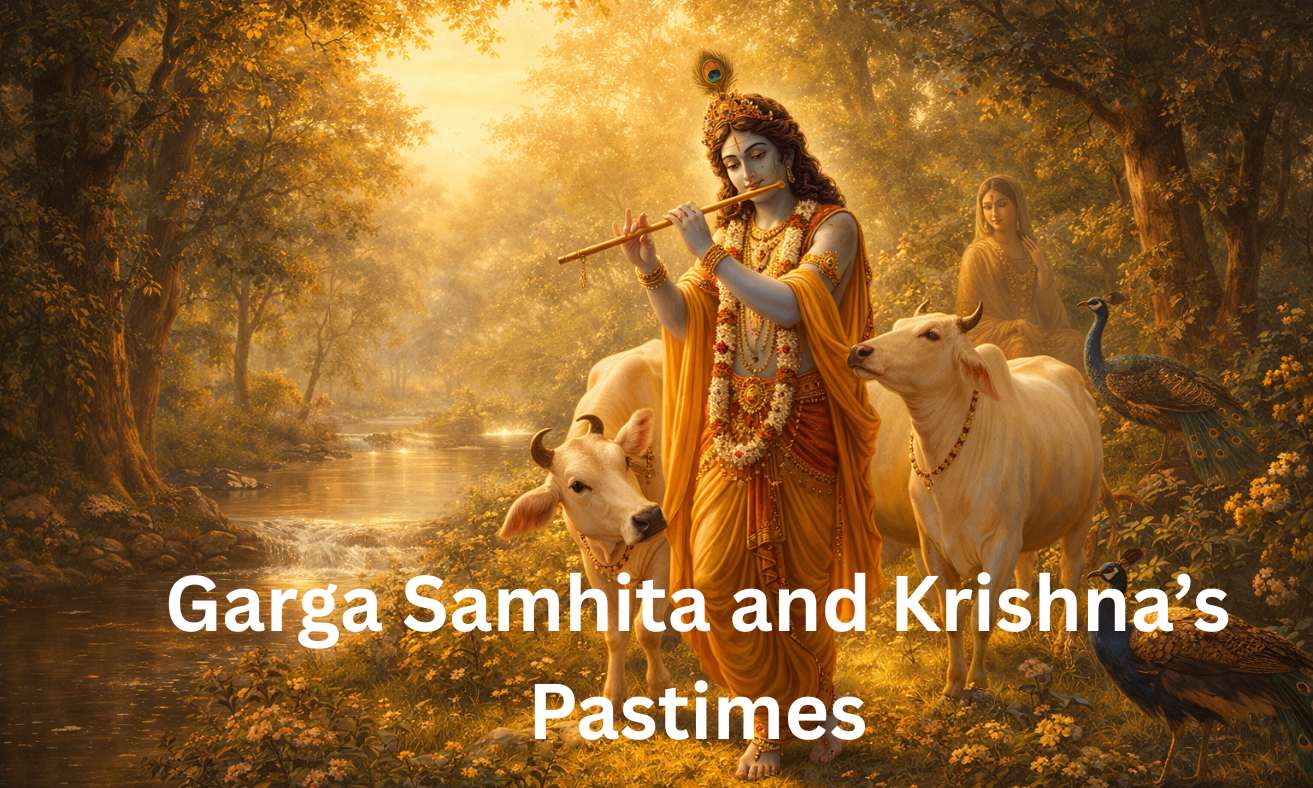
Garga Samhita and Krishna’s Pastimes
Introduction: The Unique Vision of Krishna’s Pastimes in the Garga Samhita
Among Vaishnava scriptures, the Garga Samhita holds a distinctive position because of the way it presents Krishna’s pastimes (lilas). Rather than narrating events in a historical or chronological style, the Garga Samhita reveals Krishna’s activities as expressions of divine love, meant to awaken devotion rather than satisfy curiosity.
In this sacred text, Krishna’s pastimes are not heroic displays of power or cosmic control. Instead, they are intimate exchanges of love, where the Supreme Lord willingly becomes subordinate to His devotees. This devotional emphasis makes the Garga Samhita especially important for those who seek to understand the heart of Krishna-bhakti.
This article explores Krishna pastimes in Garga Samhita in depth—how they are presented, what spiritual truths they convey, and why they occupy such a central place in Gaudiya Vaishnava philosophy.
Understanding Krishna’s Pastimes in Vaishnava Theology
In Vaishnava philosophy, Krishna’s pastimes are known as lila, meaning divine play. These pastimes are not created by material necessity or karma. They are:
- Eternal and transcendental
- Free from material desire
- Manifestations of Krishna’s internal energy
- Meant to attract the conditioned soul toward devotion
The Garga Samhita repeatedly emphasizes that Krishna’s lilas should never be mistaken for ordinary human activities. They are spiritual realities, accessible only through devotion and humility.
How the Garga Samhita Approaches Krishna’s Pastimes
Unlike other Puranic texts that provide detailed chronological narratives, the Garga Samhita presents Krishna’s pastimes selectively and thematically.
Key Features of This Approach
- Focus on Vraja-lila, not royal or political events
- Emphasis on emotion, relationship, and rasa
- Minimal attention to warfare or cosmic displays
- Repeated clarification of the transcendental nature of these activities
This approach ensures that the reader’s attention remains fixed on devotional essence, not external detail.
Read Also:- Who Wrote Garga Samhita?
Vrindavana: The Eternal Setting of Krishna’s Pastimes
In the Garga Samhita, almost all of Krishna’s pastimes take place in Vrindavana, which is described as the supreme spiritual abode.
Vrindavana as a Living Reality
The text presents Vrindavana as:
- Eternal and self-manifest
- Non-different from Krishna Himself
- Conscious and devotional by nature
Trees, rivers, cows, dust, and even the breeze of Vraja are portrayed as participants in Krishna’s pastimes, not passive surroundings.
Why Vrindavana Is Central
Krishna performs His sweetest lilas in Vrindavana because:
- Devotees there do not worship Him as God
- Love is spontaneous and uncalculated
- Intimacy replaces awe and reverence
The Garga Samhita teaches that Krishna prefers love over worship, and Vrindavana alone offers that mood.
Krishna’s Childhood Pastimes: Love Beyond Majesty
One of the most touching aspects of the Garga Samhita is its portrayal of Krishna’s childhood pastimes.
Krishna as a Dependent Child
Krishna is shown as:
- Mischievous and playful
- Afraid of His mother’s scolding
- Dependent on His parents’ affection
- Delighted by simple gestures of love
Mother Yashoda, in particular, is portrayed binding Krishna with ropes—not of strength, but of affection.
Spiritual Meaning of These Pastimes
These childhood lilas teach a revolutionary Vaishnava truth:
The Supreme Lord allows Himself to be controlled by pure devotion.
Power bows before love, and omnipotence yields to affection.
Cowherd Pastimes: Friendship with the Supreme
As Krishna grows, the Garga Samhita highlights His cowherd pastimes with friends in Vrindavana.
Krishna Among Equals
Krishna:
- Herds cows with His friends
- Plays games and accepts defeat
- Shares food without hesitation
- Laughs, jokes, and rests beside them
His friends do not recognize Him as God—they treat Him as their own companion.
Philosophical Insight
These pastimes demonstrate:
- Equality as a form of devotion
- Freedom from fear in divine friendship
- Joy as a spiritual experience
The Garga Samhita shows that Krishna delights most when He is forgotten as God and loved as a friend.
The Spiritual Significance of Krishna’s Flute
Krishna’s flute appears repeatedly in His pastimes within the Garga Samhita.
The Flute as a Symbol
The flute represents:
- Krishna’s call to the soul
- The irresistible pull of divine love
- The voice of the Absolute inviting surrender
When Krishna plays His flute, devotees forget all worldly duties and identities.
Deeper Meaning
The flute is hollow, symbolizing:
- Freedom from ego
- Complete surrender
- Availability for divine expression
The Garga Samhita teaches that Krishna expresses Himself most fully through empty, surrendered hearts.
Radha-Krishna Pastimes: The Core of the Garga Samhita
The most sacred and carefully presented pastimes in the Garga Samhita are those involving Sri Radha and Sri Krishna.
Presented with Reverence and Protection
These pastimes are:
- Never narrated casually
- Always framed within philosophy
- Surrounded by caution and humility
The text repeatedly warns readers not to interpret these lilas materially or emotionally.
Radha’s Central Role
Krishna’s pastimes reach their highest expression only in relation to Srimati Radharani, who is described as:
- The embodiment of pure devotion
- Krishna’s pleasure potency
- The controller of Krishna through love
Without Radha, Krishna’s lilas remain incomplete.
Separation and Longing in Krishna’s Pastimes
An important feature of the Garga Samhita is its emphasis on separation (vipralambha).
Why Separation Is Important
The text teaches that:
- Separation intensifies love
- Longing deepens remembrance
- Absence increases attachment
Radha and the gopis experience separation not as despair, but as heightened devotion.
Philosophical Meaning
These pastimes reveal that:
- Love does not depend on physical presence
- Remembrance itself becomes service
- Longing is a form of divine union
The Gopis and the Highest Expression of Love
The gopis occupy a central place in Krishna’s pastimes within the Garga Samhita.
Nature of the Gopis’ Devotion
Their love is:
- Completely selfless
- Free from desire for liberation
- Focused solely on Krishna’s happiness
They do not seek Krishna for personal fulfillment—they exist for His joy alone.
Protection Against Misinterpretation
The Garga Samhita strongly warns against:
- Imitation of gopi-bhava
- Material interpretation
- Sensual misunderstanding
The gopis’ love is presented as spiritual perfection, not emotional indulgence.
Rasa: The Organizing Principle of Krishna’s Pastimes
Krishna’s pastimes in the Garga Samhita are organized around rasa, or divine relationship.
Major Rasas Highlighted
- Vatsalya (parental affection)
- Sakhya (friendship)
- Madhurya (conjugal love)
Each rasa reveals a different aspect of Krishna’s personality, yet all are purely spiritual and eternal.
Why Rasa Matters
The Garga Samhita teaches that:
- Truth is relational
- God reveals Himself according to love
- Devotion shapes experience of the Absolute
Why Krishna’s Pastimes Require Proper Qualification
A unique aspect of the Garga Samhita is its repeated emphasis on eligibility.
Required Qualities
The text stresses:
- Humility
- Purity of intention
- Discipline
- Guidance under a spiritual master
Without these, Krishna’s pastimes can be misunderstood or degraded.
Role of Parampara
The scripture emphasizes receiving knowledge through:
- Guru
- Vaishnava association
- Disciplic succession
This preserves the sanctity of Krishna’s lilas.
Spiritual Benefits of Hearing Krishna’s Pastimes
According to the Garga Samhita, hearing Krishna’s pastimes:
- Purifies the heart
- Destroys material desires
- Awakens dormant love
- Leads to constant remembrance
Hearing is not passive—it is active devotional service.
Krishna’s Pastimes and the Ultimate Goal of Life
The Garga Samhita is clear that Krishna’s pastimes reveal the ultimate purpose of existence.
Not Liberation, But Loving Service
The text emphasizes:
- Liberation is secondary
- Merging into Brahman is rejected
- Eternal service in Vraja is supreme
Krishna’s pastimes invite the soul not to escape the world, but to enter divine love eternally.
How Devotees Should Approach Krishna’s Pastimes Today
The Garga Samhita implicitly guides devotees to:
- Read slowly and respectfully
- Avoid curiosity-driven reading
- Combine hearing with chanting
- Seek guidance
- Cultivate humility
Krishna’s pastimes are meant to be entered through devotion, not intellect alone.
Conclusion: Krishna’s Pastimes as Eternal Reality
In the Garga Samhita, Krishna’s pastimes are not distant myths or symbolic stories. They are eternal realities, continuously manifesting for receptive hearts.
They teach that:
- Love conquers God
- Intimacy surpasses majesty
- The soul’s destiny is participation in divine play
For those seeking a deeper, more intimate understanding of Krishna, the Garga Samhita offers one of the most profound revelations of Krishna’s eternal pastimes rooted in pure devotion.

 Blue Moon